Showing posts with label movie. Show all posts

Wednesday, April 19, 2017

August 2016-February 2017: My reviews for Seattle Screen Scene

The Lure (Agnieszka Smoczynska, 2015): Review


Ixcanul (Jayro Bustamante, 2015): Review


Kensho at the Bedfellow (Brad Raider, 2016): Review


Our Little Sister (Hirokazu Kore-eda, 2015): Review 
(full review, updated and expanded from the earlier capsule review)


Monday, July 25, 2016

April-June 2016: My reviews for Seattle Screen Scene

Knight of Cups (Terence Malick, 2015): Review 


Louder Than Bombs (Joachim Trier, 2015): Review


Our Little Sister (Hirokazu Kore-eda, 2015): Capsule review


Long Way North (Remi Chaye, 2015): Review


Under the Sun (Vitaly Mansky, 2015): Capsule review


Sunset Song (Terence Davies, 2015): Review


Neon Demon (Nicholas Winding Refn, 2016): Review


Swiss Army Man (Dan Kwan & Daniel Scheinert, 2016): Review


Wednesday, March 23, 2016

Text and Self: The Clouds of Sils Maria (Olivier Assayas, 2014)


"The text is like an object. It's going to change perspective depending on where you're standing."

And as the director, Klaus Diesterweg (played by Lars Eidinger), tells the journalist, the experience of the play, Maloja Snake, will be different for every audience member, each bringing his or her own personal subjective weight to bear on that elusive textual object.

So, I have to ask, would this film have played differently for me were I 20-something, instead of 40-something? Would I, perhaps, be more interested in Valentine (Kristen Stewart) or Jo-Ann (Chloë Grace Moretz), than Maria Enders (Juliette Binoche), a woman confronted by youth - as something startlingly distant from herself - at every turn? I am drawn to Valentine, particularly, of course, and Stewart's performance is as good as they say, but in her, I am startled, like Maria, to see a projection of what I thought I was, not what I am.

I am confronted, week to week, in my capacity as a professor, by 17-22 year old college students, living a moment in their lives that I remember so vividly: that passion for new ideas, that excitement in throwing off perceived tradition, that confident sense of self and one's own "barbaric yawping." For them, the Transcendentalists make the most sense: "Trust thyself"? Of course. "Speak the rude truth"? What other way of speaking can there be? "Absolve [me] to [my]self"? Oh, yes, indeed, they know they shall "have the suffrage of the world."

It is, truly, a thrill to watch such bold living and speaking, but there is, too, as time crawls every more quickly on, an increasingly bitter sting at the end of each quarter, when these bold young beings leave me without a backward glance. Some, it is true, stop to thank me, to wish me goodbye, but most do not think the life of a 40-something professor is truly of much interest - not with their own lives, stretching before them. They simply cannot imagine what mine is and can't really care. And it is right that it should be so. I cannot, as Maria does of Jo-Ann, ask them to pause, for just a few seconds more, as they walk out the door. The poignancy in those seconds would be only for me. No, it is a "little life," after all, "rounded with a sleep," and I see, more and more, as only one of the "players," I cannot take more than my fair share of "exits and . . . entrances."

I am not of their moment, not anymore. Someday, they shall be in mine though that is not really a thought that brings much comfort. They, surely, just as I am now, will be looking backwards to their own youth, not forwards to wherever I am.

Maria, so viscerally and vulnerably performed by Binoche, for me, then, embodies, with an almost unbearable truth, something of the journey of age I feel and resist and give in to and resist and give in to every day, the "rag[ing] against the dying of the light" and the sighing in acquiescence taking almost equal turns. She is someone learning that the narrative isn't really about her - or at least, it is her narrative, she is in it, but her part may not be very important to anyone else. She may cry out in excited questioning, as the rolling clouds and mist stream into the distant valley, "Is that the Snake? Is that the Snake?" but as she turns to the expected audience, she'll find no one is watching, no one listening. Only the still, looming mountain remains, unmoved by the little drama.

I wonder. Next time I watch this, will Rosa Melchior, mostly off-stage, forgotten by most, be the figure who inhabits my mind?


Wednesday, January 6, 2016

Mustang (Deniz Gamze Ergüven, 2015)


“Are you afraid?” said the North Wind.
“No!” she wasn’t.
                –“East of the Sun and West of the Moon”
It might be tempting to read Deniz Gamze Ergüven’s beautifully confident feature film debut, Mustang (France’s official entry to the Academy Awards), exclusively as a portrait of the situation women face in Turkey today.  The situation, while it should  continue to concern those interested in in women’s rights , however, is too complex to be contained by a film that traces the story of one family of daughters in one part of Turkey, and I do not believe Erguven’s film should be, or is even intended to be, reduced to an examination of the particular issues faced just by women in the filmmaker’s own country, however much the story is, in fact, inspired by her experiences there and by her concern for Turkish women. She has noted  for example, that the inciting incident at the film’s beginning is one very similar to an episode in her own childhood, and she has also said that she “put many . . . stories that I heard in Turkey into the film.”
So while the film is, certainly, culturally specific in significant ways, it reads more as a fairy tale or a folk tale than as a slice of life story.  As such, its themes resonate as much for me, an American woman, as they might for anyone. Folk tales invite us to consider direct applications for the readers, and here, viewers might do the same, apply and identify. The five sisters at the center of the story and living at the edge of the Black Sea are very much like the sisters you might find in the Norwegian tales of East of the Sun and West of the Moon  collected by Peter Christen Asbjørnsen and Jørgen Engebretsen Moe, a book, gorgeously illustrated by Kay Nielsen, that I grew up with and pored over, and, embracing any hints of fantastical Other, identified with.
Though I am the eldest and only daughter in a family of four, somehow, the tales spoke to or into my sense of self, idealized or real. I had no sisters, but the sisters of, say, the tale of “The Three Princesses in the Blue Mountain” seemed to represent some version of the closeness I felt with other girls, particularly, my best friend, and she and I imagined perilous adventures for ourselves that mirrored those the sisters faced in the hall of the trolls. Our hair, too, was long in those days; we even competed about whose hair was the longest and practiced the best ways of brushing it so that it shone most, but in play, that hair was tangled and unheeded; at the height of an adventure, what did it matter, after all? By our wits and our stout hearts, not our beauty, we’d escape the evil orphanage and make our way through Dinosaur Island to safety, muddied and triumphant.
The sisters of the Blue Mountain, with the long hair and bravery we imitated, are akin, then, to the sisters in Mustang, though the sisters in the Norwegian tale find a happy ending in marriages, and, in direct contrast, it is marriage –and the cultural, restrictively gendered assumptions that surround it – by which the Turkish sisters find themselves specifically pinioned.  Marriage, here, is no happy end; it is a complex threat to identity. . . .
To continue reading, please see the full review at Seattle Screen Scene: Mustang review, Seattle Screen Scene 

Saturday, November 14, 2015

A Summer at Grandpa's (Hou Hsiao-hsien, 1984)


This inspiration for Hayao Miyazaki's My Neighbor Totoro is a total delight.

Hou builds a space in which a world from a child's perspective is at once baffling and sad and exuberantly joyous: it struggles to comprehend a sick parent who cannot leave a bed but rejoices in all-consuming splashing play by the river.

It is a perspective that sees, in one moment, only the minutest of details, and in another, feels lost in a vast world. Food remnants, left by untidy, unheeding adults litter the floor of the train, but that focused, compact space of a set of train seats is suddenly a bewilderingly large expanse when the adults are absent.

Time speeds by in the morning, while turtle races absorb hands and eyes, but seconds tick interminably in the long afternoon, loose limbs lazing on the floor of a hot room.

Family is everything, dictating life's motions and providing the structure, comfort, love, but adults are capricious, mysterious creatures. Why does Grandma weep as she folds the clothes, and why does Grandpa chase away Uncle one moment and give him money the next? One can only stare, wonder, and shrug. That's Grandma. That's Grandpa. And it's nice, anyway, to sit with Grandpa and look at those old pictures while the sound of the phonograph plays its scratchy tunes.

And so, Hou's sense of space and perspective draws me in, and even when the summer comes to a close, and with the children, I am, perhaps, ready to go home, back to the routine of life, I cannot help but feel that sweeping vistas of the green paddy fields, the rush of the train just outside grandpa's window, the place on the landing where everyone's shoes snuggled against one another, have left an imprint on the mind and heart, much like those long magical summers of my own childhood have done for me. I can never go back to the time, but it remains, like a still center at the core of something that is me.

Thursday, August 13, 2015

Phoenix (Christian Petzold, 2015)


Ash, ash–
You poke and stir.
Flesh, bone, there is nothing there–

A cake of soap,
A wedding ring,
A gold filling.

. . .

Out of the ash
I rise with my red hair
And I eat men like air.

~Sylvia Plath, “Lady Lazarus”


I confess, I found myself a bit disappointed when I learned Christian Petzold’s new film, Phoenix, would be “about the Holocaust.” There is a certain weariness that arises out of the fact that so many use or have used the events of the Holocaust as a reference point, whether artistically, for a film’s central story (see Sophie’s Choice, Schindler’s List, The Pianist, among others) or socially, for a cheap point in a debate gone awry (see my Facebook feed). I wondered whether I was up for seeing yet another movie centering around the much-documented tragedy.

But great artists work familiar things in such unfamiliar ways that even the cliché can take on unexpected, fresh resonance, and I see the familiar thing as I had not seen it before. It is both old and wholly new. Artists use myths, for example, in this way, and myths, in deft hands, never lose their power; Shakespeare would not be Shakespeare without his unashamed foraging through Ovid. Like myths, then, the Holocaust can be a powerful touchstone for describing our world. It can be a story that artists return to it over and over, mining for its significance, finding in it a means of plumbing the human soul, locating parallels with which to describe and understand the world.

And it is with a delicate, deft artistry that Petzold, in Phoenix, not only tells a fresh Holocaust tale but weaves it together, with beautiful ease, with two myths: three old and familiar tales together becoming an astonishing, new thing. . . .

Read the rest over at Seattle Screen Scene.

Saturday, July 4, 2015

Caving to Quirk, or Something: Me and Earl and the Dying Girl (Alfonso Gomez-Rejon, 2015)


(My expanded review now available at Seattle Screen Scene. Below is an excerpt.)

A good deal of my enjoyment of this one must have been reactionary. I found The Wolfpack so thoroughly depressing (and not for the reasons I think the filmmaker wanted) that going directly afterwards into a screening of this - a cliché-ridden load of indie quirk that did almost nothing surprising - was somehow just the ticket.

I ought to have been annoyed by the cute title cards; the ridiculous portrayal of a hipster tattooed high school history professor (who somehow has his own office and sports a Persian carpet in his classroom?) and of a tenured sociology professor father (who, because tenured never has to work?); the manic pixie dream dying girl who lives, er, dies, to serve the protagonist's emotional development; the bordering on racist depictions of black characters (because Earl, his brother, and the limo driver are funny, it's ok, I guess?); the look-at-me-I-know-all-these-films film references; and on it goes.

I dunno, maybe it was The Wolfpack; maybe I was just so barraged with cute quirk that I caved; or maybe there is some cheap satisfaction I find in knowing and being able to laugh at those movie references and I'm shallow. Whatever it was, I admit it. I had fun.

Also, "Eyes Wide Butt." That's pretty funny.


Friday, July 3, 2015

The Wolfpack (Crystal Moselle, 2015)


(My expanded review available at Seattle Screen Scene. Excerpt below.)

A maddening documentary for opposite reasons: sloppy story framing and contrived framing. In many moments, context, chronology, and even character are so muddled, that even the compelling subject matter fails (and I was left feeling guilty that I just didn't care), and in other moments, the purportedly candid, spontaneous scenes (the trip to Coney Island, the phone call) feel anything but candid, and I wondered, uncomfortably, just how much the director was directing (eg. I imagine this: "Could you say that again, but include how many children you have and how long it's been since you've seen your mother?").

The sloppiness, I think, is an aim at artfulness - and in the hands of a more experienced director and editor, the cuts from one contextless scene to the next could have added up to emotional depth and a clearer arc. There are enough poignant moments - the camera held on the face of one boy or of their mother, a scene of vibrant dancing and running down tight hallways - that I can see the glimmers of a powerful film in the tangle. As it is, so artless, I felt uncomfortably complicit - in the act of watching - in something bordering on the exploitative and sensationalist.

The choice to make the boys essentially nameless is also unsettling; we get a recital of their names at the beginning, but throughout the film, those names are lost in the "pack." It is a deliberate choice, of course, to show the boys as so tightly connected to one another - a survival mechanism, a mechanism forced on them, too, given the tight, prison-like living quarters - but the effect of the choice is that it alienates me from the boys as individuals, from their stories. The larger story remains fuzzy, distant, cold.

And then, wandering round the edges of the film, acknowledged once initially and then mostly forgotten, is the sister who is "special," a lonely vulnerable figure who holds the deepest poignancy for me; I left the cinema worrying for her most, and, ironically enough, it is her name, Vishnu, alone that I remember though even the director herself doesn't seem very interested in her.

I believe Crystal Moselle's heart is in the right place - the film feels like a sincere effort to tell a story and to tell it truthfully - but the skill, or lack thereof, undermines the effort too much to be able to recommend the film. As my friend said to me as we walked out of the cinema, "I wish we'd just read an article about this family instead." And given the cinematic interests of the boys in the family - their own love for film, and film, like their pack grouping, being a tool of survival for them - it's a real shame. I wonder how they themselves will feel about this documentary about them, particularly when they (re)watch it years from now, more distant from the situation of their growing up?


Friday, June 19, 2015

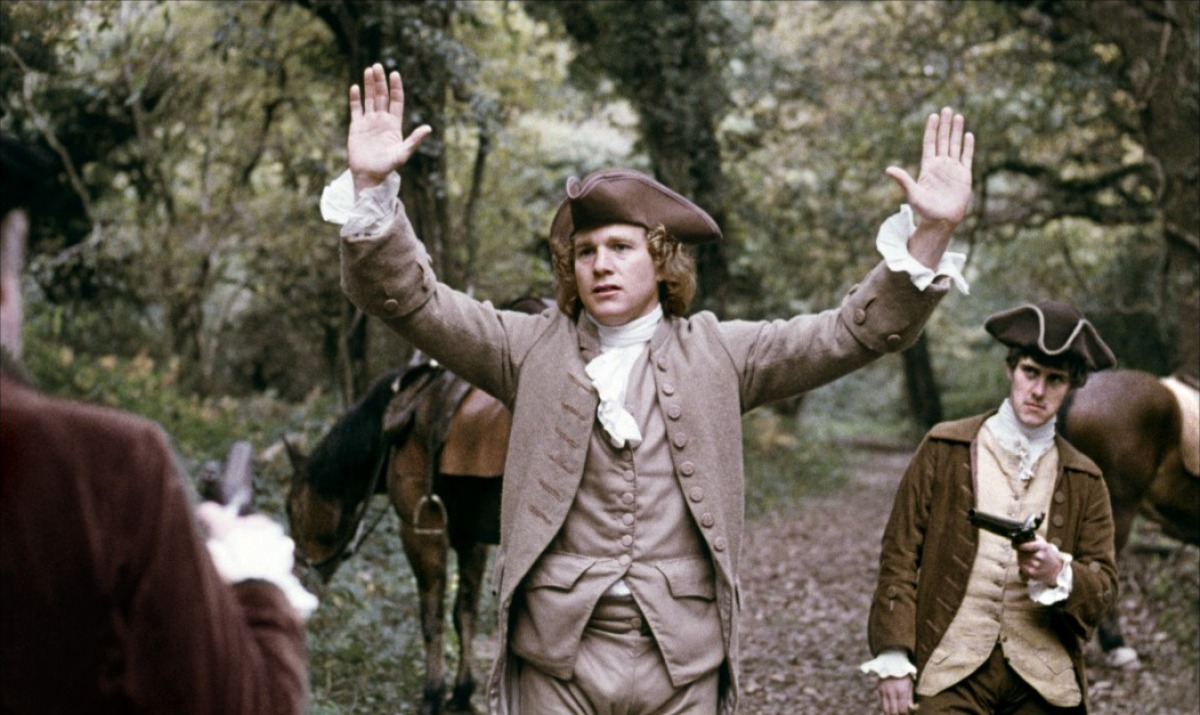
Bland Barry: An Epic about a Thoroughly Mediocre Fellow: BARRY LYNDON (Stanely Kubrick, 1975)


One of the most interesting things about Barry Lyndon is that he's boring. He's a bit stupid - but not enough for me to feel sorry for him; he's a bit pompous - but not enough for me to hate him; he's somewhat good-looking - but not enough to inevitably draw the eye; he shows some bravery - but it's a workaday sort that anyone might show; his beginnings are poor - but not too desperately poor; his end has some tragedy - but it is not terribly so (he does get to keep his knee and 500 a year).

And so the grandeur of the vehicle that carries him - an epic film - epic in length, epic in beauty and filled with wars and duels and love affairs and wealth - is perhaps the great joke: an essentially average person, someone I neither love nor hate, gets the title card.

Is Stanley Kubrick giving me a conspiratorial elbow to the ribs or a mocking grin? I am not sure if I am in on the joke or the butt of it, for while I can see the irony of the thing, I cannot, in the end, easily distance myself from it. I am uncomfortably suspicious of two things: one, that every film, every story I've ever watched or ever read is not really about a hero at all (perhaps even the idea of a protagonist is bogus); they all feature average, boring people; I've just been fooled by the accoutrements. Two, that we are each terribly average - and well, a bit boring - in spite of the central role we each feel we play in our own lives.

When presented finally at court, a title carries no real consequence, and the king, however polite, cannot really place the man with the grand title as one of those among his acquaintance and within his respect.

Barry Lyndon is only Redmond Barry after all.


Tuesday, June 9, 2015

"Let's Listen" - The House Is Black (Forugh Farrokhzad, 1963)


"Alas, for the day is fading the evening shadows are stretching. Our being like a cage full of birds is filled with moans of captivity."

This documentary, following the lives of those living in a leper colony, is the only film of Forugh Farrokhzad, a woman Iranian poet, who died at 32, only four years after making the film, but it is, at 21 minutes, spare and powerful, and it is no wonder that it is credited with sparking the Iranian New Wave.

She films as you might expect a poet to do - layering spoken verse (from the Bible, the Koran, and Farrokhzad's own poetry) with potent, select images, each image speaking volumes, some images repeated - all together creating threads of being and feeling.  At first, one feels horror - the toeless foot with scissors snipping away at dead flesh, the eyeless face, the noseless face - but horror quickly falls into sympathy and then into something more complex, something like empathy. - What is that? That is a person. That is someone like me. -

The film ends in a schoolroom of children, some adults around the edges.
"You. Name a few beautiful things," says the teacher.
The boy student pauses. "The moon, sun, flowers, playtime."
To another student, "And you, name a few ugly things."
Another pause.
"Hand. Foot. Head."
I, watching and listening, feel a shock of sympathy - in this boy's life, the human body is an ugly thing.
But, as in a gentle contradiction to my response, those in the school room do not cry.  The room erupts in laughter. Laughter. And the boy's eyes light up; he ducks his head, a sweet modesty in having unexpectedly made a joke.

Like the best kind of film, this film shows me my own failures to see and understand - and makes me see, makes me feel. And the world is suddenly much richer.

"Let's listen to the soul who sings in the desert."

Saturday, April 4, 2015

Musings on Poetry and Interstellar (Christopher Nolan, 2014)


A friend of mine - a former student and a budding poet, headed for an MFA in poetry program this fall – recently told me that the more he works his craft, the more he finds he wants to compress, the more he wants to replace an initial phrase with a single word or to replace a set of phrases with just one brief phrase. The idea is to create a work full of just a few potent words - words that contain multitudes, so to speak - instead of a work full of many less resonant ones.

What he wants to offer the reader, I think, is something like a seed, a latent, fertile thing that, when planted in the reader’s mind, germinates and expands. And his poetry, as I read each new poem he sends me, is increasing in these kinds of compression-fueled expansions. His work is, more and more, made up of compact sets of lines that feed a reader’s delight: they puzzle at first in their bold brevity – but then, as I sit with a particular poem, letting my tongue savor the sounds and my mind mull the possibilities, a meaning will open as with a sudden blooming, and then there's another, and another meaning, until the poem fills all my thoughts and feelings – and I find I have been a participant in that deeply personal discovery that readers of poetry often feel, a discovery dependent upon that unique, intimate interaction between poem and reader.

Poets like my friend understand that poetry is not really poetry if it has no reader; to even exist, it, in some sense, needs a reader, a reader willing to grasp, plant, and water those word-seeds. The poet depends on readers for the poems to live. And the reader, likewise, understands that there is very little joy in reading if the poet does not trust the reader enough to allow the reader to do the nurturing, to offer care and feeding to those seeds.

A poem, then, might be considered not as a thing on a page but as an interaction, a relationship. And the greater the trust and investment on both sides, the greater the love, the greater the joy. As Jeanette Winterson writes in her essay, “Imagination and Reality,” “Love is reciprocity, and so is art.”

But if the use of Dylan Thomas’s “Do Not Go Gentle into That Good Night,” in Interstellar is any indication, I do not think Nolan understands that about poetry: that latent fertility of a poet’s words, that need for trust between poet and reader.

And perhaps he doesn’t even understand how much the visual, sensory building blocks that make up the cinematic experience can be like those potent word-seeds we find in poetry, visual and sensory things that truly bloom only when allowed to be planted in the mind and heart of the viewer.

For Nolan does not trust that Thomas’s words contain a potency that needs no explaining, no repetition.

Nor does he trust that his own visuals will tell the story he wants to tell.

Instead, he lectures through the mouths of his characters, telling us what to think. He harangues with a deafening, ever-present score, telling us what to feel.

Virginia Woolf in her brilliant and provocative essay, “How Should One Read a Book,” writes, “The impact of poetry is so hard and direct that for the moment there is no other sensation except that of the poem itself. What profound depths we visit then – how sudden and complete is our immersion! . . . Our being for the moment is centred and constricted, as in any violent shock of personal emotion. Afterwards, . . . the sensation begins to spread in wider rings through our minds; remoter senses are reached; these begin to sound and to comment and we are aware of echoes and reflections.”

But Nolan will not let that “hard,” “direct” “sensation” of Dylan’s brilliant words or of his own visuals reach the “profound depths” they have the capacity to do. Instead of being “centred and constricted,” instead of having the joy of “sensation” “spread[ing] in wider rings through our minds,” we have only a strident bombast, and in leaving the theater, we leave with very little that is ours. No relationship has been established, no seeds have been planted in the mind and heart and allowed to grow and delight us with their secret and expansive growth.

And it’s not that every piece of writing needs to be a poem to offer satisfaction. And not every film needs to offer the subtle delight of densely resonant visuals that tell their own story, sans explicit explanation. The non-fiction essay and the pulp novel offer their own delights as does a simple genre film - a rom-com or an action flick.

But the disappointment here is that Nolan seems to believe that any move towards complexity, away from a simple genre film, necessitates lengthy, direct explanation. We do need those lengthy explanations sometimes –say, in scientific essays and political editorials. But a fiction film is neither an essay nor an editorial - and should not complexity be broached differently, so as to make full use of the unique medium of film, so as to invite the viewer into joys of the cinematic relationship?

I try to imagine what 2001: A Space Odyssey would have been had Kubrick put explanations of the monolith into the characters' mouths. Would not the thing lose its potency? As it is, that monolith sits like a provocative weight in the mind, growing in density and meaning throughout the film and in the aftermath of the film, as I sit at home or in my car and ponder. It grows in meaning and significance exactly because it's given wholly to the viewer, and the viewer must interact with it, decide what it is, what it means. And so the monolith becomes personal. It's no longer exterior to me, but it sends ever "wider rings" of resonance through my mind - and it has, indeed, taken on such resonance in so many minds since 1968, that it appears again and again in the film world and elsewhere - and is now a part of our cultural cache, a thing, as Yeats might put it, of the Spiritus Mundi , containing multitudes, containing both Kubrick and his ideas and ourselves. Nolan ought to know all that, for his use of the monolith in figures of TARS and CASE gives him no excuse not to know it. The monolith needed no explanation to be powerful – in fact, it is powerful still because it lacks direct explanation.


Total ambiguity in the realm of art is, of course, frustrating – a slosh of vague symbols with no clues as to their meaning(s) and contributing to no discernible pattern can make a reader or a viewer feel betrayed.

There is the other problem, too, that the perhaps the artist is not actually offering a complex or satisfying set of meanings and ideas, and mulling over a work from from such an artist leaves us essentially empty handed.

My friend’s poems work because they do not remain, ultimately, ambiguous, and the ideas and meanings they contain, once discerned, satisfy the intellect and heart. It’s worth it to invest myself in the poetry he sends me because I know, as a reader, I will be rewarded for my trust, for my belief that the poem is worth investing myself and my time in.

Nolan’s film avoids ambiguity (perhaps) as it layers exposition upon exposition, assuming, apparently, that the complexity of the film is too much for the viewer, but in the end, ironically, the film’s central idea seems trite and unsatisfying, very little more than a shallow sentiment about love transcending time and space.

Nolan has the skill, I think, to offer something visually, viscerally arresting and resonant. But as of yet, particularly in recent years, I am less and less rewarded as a viewer – in large part because, even if the ideas are shallow, Nolan will not give the trust to the viewer that the viewer has given to the films. There is no deeply significant interaction between filmmaker and viewer.

Winterson writes of the interaction between artist and viewer, “The exchange that art offers is an exchange in kind; energy for energy, intensity for intensity, vision for vision. This is seductive and threatening.” And then she asks, “Can we make the return? Do we want to? Our increasingly passive diversions do no equip us, mentally, emotionally, for the demands that art makes.” Winterson, here, puts the pressure on us, as art-consumers, to offer ourselves to the art, to be consumed as much as we consume – if we want to be fully rewarded by the art.

Does Nolan’s work and his level of investment in me as a viewer merit my own return? I am increasingly uncertain that the answer is, “yes.”

Tuesday, January 6, 2015

The Missing Picture, a film by Rithy Panh (2013)


"How do you revolt when all you've got are black clothes and a spoon?"

How indeed, when everything is stripped from you, is there space for anything but survival - and in the surviving, what is left but grief, guilt, loss? But here, now, Rithy Panh stages his revolt, as the only means to continue living. Here, using crude clay, as if using the very stuff of his being and of the flesh of those he buried, Panh builds images of what he lost - and builds it on his own terms.

Where the Khmer Rouge had seized photos to destroy the threat of the personal and of the individual and created new films to promote political ideology and lying glory, Panh seizes images in return, taking such filmed ideology, and frames it, transforms it: adding his clay figures -much more powerful figures than the clapping, smiling Pol Pot - adding his narration - much more powerful than the screaming of slogans - and reclaims his past, his color - not black but pink, yellow, and red - his family, his story, himself. The crude clay speaks while the black and white film of the regime merely mumbles incoherently.

Still, it would be a mistake to pretend Panh is not a haunted man. There is no healing, not really, not fully, even in such powerful artistic revolt. "It's not a picture of loved ones I seek, I want to touch them. Their voice is missing," he says.

Even his own voice, in the boy he was, is lost to himself: "It's the boy; he seeks me out. He wants to speak to me, but words are hard to find."

The words, the memories, the images are hard to find, and even "Mourning is difficult. There is no end to the burial. . . . There is the blood drenched earth. Their flesh is mine, so we are together."

And so the film ends, with the burial of a clay figure - buried, being buried, being buried - and it is a figure, a picture, I cannot easily forget.

Thursday, April 17, 2014

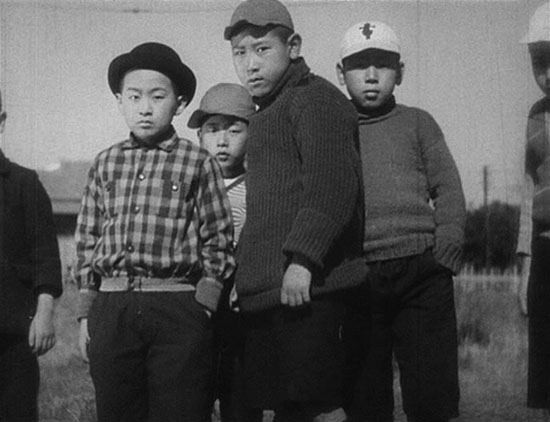
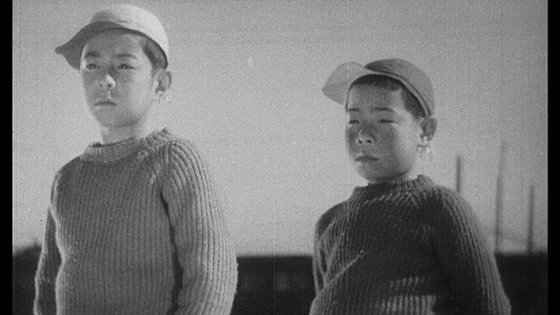
I Was Born But . . . (Yasujirô Ozu, 1932)


“Can your dads take out their teeth like my dad?”

Jostlings for superiority, shufflings for power, and contests of strength –  flurries of action that settle into hierarchies – these games are played out in the neighborhood spaces where boys vie for sparrows’ eggs and in the workspace where men vie for the biggest laugh from the boss. Who eventually becomes general, who becomes lieutenant general, and who becomes the one slain by an invisible bullet firing forth from the finger of another is as arbitrary and ridiculous as it is terribly serious.


The revelation that a father’s position relies on such arbitrary and demeaning ridiculousness disrupts two boys’ own sense of position and self. Indignant and grand, the boys – one virtuously, one reluctantly – lodge their protest, refuse their rice. Grandness can be maintained only so long though, and virtue yields to the pains of the stomach. In such acquiescence comes further revelation, or rather, more poignantly, self- recognition: the boys know that they and their father, in the end, walk in the same world, play the same games.

Is this tragedy? Is it comedy? It depends, perhaps, on one’s point of view.  Here, at any rate, Ozu’s light touch makes room for nuance, for both comedy and tragedy - and also, maybe more importantly, for tenderness. In the midst of the jostlings, the games, the indignation, and sad realizations, there is the comfort of a steaming kettle, of a parent’s affectionate gaze on a child’s sleeping face, of a plate of rice offered in peace, and of a look of understanding passed between father and son. 

Wednesday, November 20, 2013

LIKE FATHER, LIKE SON, a film by Hirokazu Kore-eda


(Note: I do not here give away the film's resolution, but I do give away a couple of pivotal beats of the film. The very spoiler sensitive may want to see the film first, before reading.)

In Hirokazu Kore-eda’s newest film, Like Father, Like Son, a group of three - a man, a woman, and a boy - walk down a hospital corridor moving towards a sunlit window, hands joined, the boy in the middle, framed by the adults. The boy skips, periodically, dances a step, and the man and the woman lift him together: a walking, dancing game made for three, where the middle person must be smallest, where the two on the outside must be stronger, where the two on the outside must lift in unison for the middle small one to leave the ground.  Any person the wrong size or in a different order, any relational change in this simple little game, and the game won’t work. I know this because I walked between my parents when I was small and they were big, and I begged them to lift me, together to the sky, and as they did, I thrilled to the leap from the earth, knowing their big, strong hands and arms would keep me from jerking about or falling back down too fast.  And I know this, too, because my own children have wanted this same game from me and my husband, to walk between us holding our hands and playing this leaping lifting dance.  This is a game that parents do with their children. It speaks of love, trust, joy, security, freedom. It is a family game. 

This group - this man, woman, and child - is framed for us, walking down this corridor, as such as a family. The action and the framing say, family. One might take a still from this sequence and hang it on a wall with the other family photos. No one seeing this photo would question that the frame has captured parents and their child. Happy parents and a happy child. But in the moment of this particular frame, the film’s narrative is not offering us a statement of fact. The framing, instead, is an interrogation, a question. Are these three, in fact, family?

At the end of the hospital corridor is an answer to that question, one written in biology, in blood. It is one that denies the family portrait given us in the corridor.

The blood’s DNA reads, “File #1 and File #2 are not related to File #3.”

“That is our conclusion,” the hospital authorities tell File #1, Ryota, the man who was father, and File #2, Midori, the woman who was mother. And File #3, the boy who was son, Keita, is suddenly a stranger. Keita is not their son; their son lives with another family, who there, too, DNA says, is a son who is not a son, whatever the family portraits on the walls might say.

In these cases, Ryota and Midori are told, 100% of the families choose to exchange. A mistake has been made that needs correction. The boys do not belong, do not share blood with those with whom they live, so they must be exchanged.

From the scientific, biological point of view, things are that simple.

Families, however, those gatherings of people within the complex human drama are not so simple, and Hirokazu Kore-eda is a storyteller who, like the great Yasujiro Ozu before him, gently explores and quietly reveals the messy tenderness, the raw heartbreak, the love, the anger, the confusion at the center of every group of people we call family. Through his films - films like Nobody Knows, Still Walking, and I Wish - Kore-eda asks, what makes a family? Who are its members, and how do we know? What kind of agency or power does each member have? What are the bonds that tie the family members? How far can those bonds be strained, if disruptions, external or internal, threaten?

Like Kore-eda’s previous films, Like Father, Like Son builds its characters and its story by slow degrees and delicate nuance. We become so immersed in the lives and narrative that Kore-eda’s questions arise organically, and the questions about family take on emotional power and urgency because we are so intimately connected with this particular family, these individual characters. We desperately want to know, does Keita belong to this man and this woman, Ryota and Midori? How can he belong to them? How can he not belong to them?

When Midori receives the devastating news from the scientific authorities, she is baffled and burdened by what she feels was her blindness, ““Why didn’t I see it? I’m his mother.” And indeed, that is a key question: shouldn’t we be able to recognize those of our own blood? Shouldn’t it be easy? Obvious? But it isn’t, not to Midori, and her mother’s heart yearns towards the boy whom she’s regarded as son; she cannot really believe that he isn’t her son, and her confused question, “Why didn’t I see it?” is not merely an intellectual dissonance but a deep heartbreak.

Ryota is a contrast to Midori, a very different personality. Early in the film, he describes Keita, as “kind,” a gentle person “like his mother,” who doesn’t mind losing; he has a softness, born of emotion, that, Ryota admits, bothers him a little. Ryota’s emotions are not things he admits nor we see easily, and his heartbreak over the news of his son is less clear. Ryota is angry; he wants to know how such a terrible thing could happen – this thing that he regards as an affront to him and all his plans for his ordered, controlled life. He works every day of the week and has risen in the ranks of his company; his motto, revealed when Midori suggests Keita take a day off from piano practicing - since Keita has just been studying hard, at 6 years old, for his entrance exams and has passed - is “If you take one day off, it takes three to catch up.” Keita must not take a day off from study or from piano because Ryota cannot give himself a day off; relaxation is not the key to the success of his universe. And so Ryota pushes himself, his son, his wife, and they live an orderly, tidy life in their home, a place Midori’s mother likens to “a hotel.”

Such is the nuance of Kore-eda’s story-building though, that we do not see Ryota as a monster. Whatever his demands of himself and his son, whatever his strictness, or his stifling demands for cold tidiness, his interaction with Keita is suffused with tenderness. It is, perhaps, a watchful tenderness, a watching whether Keita will fit the mold Ryota has set out for him, but it is a tenderness nevertheless, and when Keita sits down to practice the piano at the end of his long day of exams, Ryota watches him for a moment, and then joins him, sitting close to him and playing with Keita a simple duet. And Midori watches with quiet delight from the kitchen, chopping her dinner vegetables in unconscious time with their music. Surely, whatever Ryota’s firm control and strivings towards his notion of success, this is a happy family whose members love one another.
   
Still, tenderness within the controlled life or not, the news that Keita is not his son is a violent disruption in Ryota’s notion of family and of the path Ryota had planned for his life. As the family leaves the hospital, the two adults stricken by the news,  the three – Ryota, Midori, and Keita - are framed again, as they were in the hospital corridor in family portrait, this time waiting at an intersection. But the neat framing of a family portrait is dashed away: interrupted by a train, swiftly rumbling by, cutting off our vision of them. They are not what they once were, what Ryota assumed them to be, what he planned for them to be. 

And this disruption of the family portrait, its notions of itself, this break in direct forward movement is further mirrored for us not only by the obfuscating train but also, beautifully, by immediately subsequent lingering shots of travel – a vehicle, we don’t know whose, moving swiftly through dark highway tunnels, and then, another vehicle moving in circles around and around a track. The outlet to the tunnel never comes, and there is no end of the circling track. In one moment, the three members of a family were walking happily down a corridor towards the lighted window of the hospital; in another moment the three are struck through by a passing train and we are travelling with them in tunnels and circles.  

The journey of the film, then, we might say centers on a man who thought he was a driver of an expensive car he’d sacrificed to earn, a man who thought he was moving forward in a path he’d chosen, with a family he was proudly caring for and shaping. And that man’s world is derailed: he no longer knows with whom he’s driving nor to where he’s driving. And for Ryota, this situation is impossible. He must know who he is and what he’s doing – any lack of definition, any emotional messiness is intolerable to him. So he goes about working to fit things back into their tidy definitions.

But the story is such that at every turn, control and definition continue, more and more, to escape his ever slipping grasp.

His control is disrupted in the moments when he first meets the family who has raised his blood-son as their own, and he reacts to these people who are not like himself in a frozen, polite stillness. They are a working class family, an open, friendly, warm, rough and tumble sort of family, where the father, Yudai, works as an electrician from home, stopping his work happily and frequently, perhaps to help a child fix a toy or to chat with a neighbor; it is a family where a childhood scrape, a bump or a bruise, is nothing to worry about, where the father joins heartily into the play of his children, mussing his hair and ruffling his clothes and not caring one jot. Whether he’s even aware of his undignified, untidy appearance is doubtful. When Ryota, Midori, and Keita meet the other family at a mall food court and playground, Ryota looks on in a kind of horror as his blood son, Ruyei, inelegantly chews at his soda straw and then leaves it, mangled, behind him as he runs off to play.  Ryota sees, later, that Yudai chews at his straw in the same way, also leaving it mangled. Like father, like son.

Ryota’s response to this horror – his blood son imitating, so crassly, the man who is not his real father - is to work to fix it; a plan begins to form in his mind that he and Midori should take both boys, since, clearly, his tidy, more moneyed life is best.

But Ryota’s notions of class are to be disrupted as much as his sense of control, and of family and fatherhood. Yudai’s family is revealed to Ryota to be something Ryota might admire rather than despise. For Ryota, working his son hard and working himself hard in order to make enough money and opportunity for his family, has been his idea of good parenting; he scorns the genial tumble play Yudai offers his children and insists, by contrast for example, that his son should bathe alone, “to learn independence,” rather than bathing in the traditional, communal family bath style, as Yudai and his family do. Yudai is unabashed by Ryota’s chilliness, however, and his motto, we learn, is “Put off tomorrow whatever you can,” and he gives advice to Ryota about fatherhood, chastising him for working away from home too much: “For children, it’s more about time. Being a father is the most important job in the world.”  Through Yudai, this new family, Ryota begins, however reluctantly, to see another approach to life.

And when Ryota suddenly, at one point, proposes to Yudai that he and Midori take both boys, we see that, in the aftermath, he is as ashamed of himself, as the others are for him. Here, Ryota is not at a point where he has relinquished all control, but he is beginning to realize his way of fatherhood is not the only way, and even while the very nature of the relationship of Keita to himself has been thrown into question, he is also beginning to question who he has been as a father.

Whatever Ryota’s growing sense of the complexity of a parent’s relationship to his child, however, both families continue to move, as if caught in an unrelenting force, towards what the hospital had told them everyone does in these cases, 100% of the time: an exchange of the boys, each blood-son to be with his blood-parents. The mistake corrected.

Even as this movement towards apparent correction reaches its peak though, the film continues to probe the rightness of that correction. The families meet together one last time for the moment of exchange, and as families do - commemorating what they deem important moments with their cameras – they decide they will take a group photo. Each father carefully places his camera on a rock: two cameras - one camera large and expensive, the other camera small and modest - each representing their respective families. Then, through the gaze of the two cameras, we look at this group of people and wonder for a moment, how will they group themselves? What will the framing of this shot be? But the question on the tenterhooks of our minds is not one the families themselves seem to think to ask at all, though they have been working with such momentum, to re-frame themselves, to learn to assert to themselves and each other, “now Keita belongs to Yudai and Yukari,” and “now Ruyei belongs to Ryota and Midori.” They simply separate, without thought, into the groupings organic to their emotional sense of identity: Keita with those he’s called parents, Ryota and Midori; and Ruyei with those he’s called parents, Yudai and Yukari. Snap. Shot. And as Koreeda has been doing throughout the film, this photo framed for us in the context of the film, asks us a question: how is a family a family? Are these people, divided into two groups, each a family? How can they be if they about change their groupings?

The instinctual gravitations of the members towards those other members most familiar to them tell us something that those in the photo do not realize, perhaps, for themselves, just how much an emotional bond has, a bond over those bonds of blood and DNA and over the decisions of that adults about who belongs to whom.  

I will not reveal the film’s ending, for to disclose it would break its slow, building power, but I must describe a pivotal moment, later in the film, in which Ryota finally understands something about the complex nature of a familial relationship, something that cannot be reduced to blood and his own decision. Ryota, now at home, idly takes up his camera and flicks through the images it stores, images he himself primarily captured, images cataloging his family unit, Keita, Midori, Keita and Midori. But he is startled to find on the camera images he did not take, framings he did not construct. There are images of himself, asleep.  In these he is far from any control of the kind of representation of himself he might choose. And this sudden exposure of the way someone else sees him – something we saw in the photo of the two families together but he did not see - disrupts his own narration of his world, and it thrusts upon him with irresistible power a thing that he has been resisting, that is, another perspective, an alternative understanding of the world, of himself, and of Keita.

John Berger says in his television series and later book, of the same name, Ways of Seeing,
Every image embodies a way of seeing. Even a photograph. For photographs are not, as is often assumed, a mechanical record. Every time we look at a photograph, we are aware, however slightly, of the photographer selecting that sight from an infinity of other possible sights. This is true even in the most casual family snapshot. The photographer’s way of seeing is reflected in his choice of subject.
 And here, in the moment of seeing Keita’s framing of his world, his way of seeing, Ryota sees Keita’s choice of subject: himself, Keita’s sleeping father. And he understands, finally, Keita’s bond to himself, and in that knowledge he finally sees in himself something he could not before, the thing that grew and became real, a thing more deeply in his heart than his very blood, a thing that happened without his conscious choice or control. In fact, a family relationship.

It is true, perhaps, that as the boys grow older, each will physically resemble more and more, their blood parents, but what that means for the definition of family is less sure, much less sure than the authoritative decision of the hospital authorities about which boy belonged to whom, for we might say that often, in the acting is the being. The boys were brought to homes, and the adults acted as their parents, became their parents. And perhaps the boys, in their newly exchanged homes, acting like sons, being treated like sons, learning to call the unfamiliar houses homes, will begin to be the sons of those whom their blood tells them they are. Indeed, we glimpse them as they learn, in their new homes, to receive and give hugs, to begin to trust those of this foreign environment.

Transplants are possible perhaps. Transplanted cicadas, for example, we learn from the film, as Ryota travels for work to a forest project, can adapt, regard a new place as home. But they do not treat a place as home until they have been in that place for 15 years; the process of belonging is a slow one.  And once rooted, the cicadas remain, live, grow, reproduce in what has been, for 15 years, home. They are attached, firmly, to that place.

The boys were, originally, transplants, and they are asked to be transplanted again, back to a time from before they can remember.

And we might ask, can any collection of individuals – individuals framed by context, by narrative, by photographs, as “family” - be anything more than a collection of wandering transplants? Just how deep do transplanted roots go?

Susan Sontag, in her classic work, On Photography, is cynical about the nature of family photographs, and by extension, family; those photographs, she implies, create a narrative and connectedness the family, insecure in its own identity, desires but may not actually participate in:
Through photographs, each family constructs a portrait-chronicle of itself – a portable kit of images that bears witness to its connectedness. . . . Photography becomes a rite of family life just when, in the industrializing countries of Europe and American, the very institution of the family starts undergoing radical surgery. As that claustrophobic unit, the nuclear family, was being carved out of a much larger family aggregate, photography came along to memorialize, to restate symbolically, the imperiled continuity and vanishing extendedness of family life.  
The photos and framings of family in Koreeda’s film are not so cynical, however. The framings do interrogate the assumptions about family, about connectedness, about a family’s narrative of itself, but the interrogation is gentle and nuanced and does not simply declare that a family photo, a framing of a family, with its implied narrative and implications of connection, is a deluded fiction. Those framings may be, in some sense a fiction – as this film shows us, what is framed as “family” is denied by the cold fact of blood -  but a fiction participated in long enough may become more than fiction. And more than being a sad fabrication of a desire that does not exist, as Sontag suggests, a photo in this film may instead reveal an emotional truth, a truth the photographer, one like little Keita, cannot hide.

In the hands of our guide, Hirokazu Kore-eda, framings of family and family photos take part in a moving, truthful narrative about human connection, and the truths Kore-eda offers in this film will long remain with me, as indeed they must, as I look around at this place I call home, with these three girls I call daughters, and this man I call husband, and as photos I’ve taken and photos my children have taken - often crazily framed, wonderfully unflattering photos - run in random sequence across my computer screen. I do not know how, exactly, we came to be family.  And I remember wondering if the strange little red, scrunchy-faced thing I brought home from the hospital, after giving birth for the first time 12 years ago, would ever feel like my own, not a transplant from some foreign place. But the truth is, once strangers and transplants or not, we are a family, and cicada-like, we are rooted and entwined with one another.

And I think, on our next family walk, we’ll see if our youngest daughter is not yet too old to be lifted high to the sky, between my husband and me, as we move along together.