Showing posts with label film review. Show all posts

Thursday, August 22, 2019

Madonnas and whores and white racial innocence: An examination of ONCE UPON A TIME IN . . . HOLLYWOOD (Quentin Tarantino, 2019)


**SPOILERS THROUGHOUT**


I. Prolegomenon: “Once upon a time,” Conservatism, and the Appeal of Nostalgia


This isn’t a review. It isn’t a judgment about whether a film is good or bad at a filmmaking level. Rather, it’s an attempt at a primarily thematic analysis. It’s an effort to answer some questions I have.

I want to consider Quentin Tarantino’s Once Upon a Time in . . . Hollywood on two levels: 1) a thematic one, specifically focusing on its construction of, assumptions about, and implications about gender and race — though, as a white person, I am more uneasy about tackling this one, aware that my own complicity in whiteness will always cloud how I observe and understand race on screen — and 2) an emotional one, arguably difficult, subjective territory, but one I think I have to address, given my own overwhelming fury upon exiting the cinema after my first viewing of the film.

First, then: what is the film saying or implying about gender? About men and about women? I believe Once Upon a Time in . . . Hollywood is, in essence, a conservative film. (And I credit my friend Ben Hynes for using this adjective in reference to the film in a conversation with me and thus, as aptly chosen words often do, doing much to illuminate and organize the clutter of details in the film I’d observed.) And by “conservative” I mean two things: first, a conservative stance is one that is, inevitably, backward looking. It looks to the past as a guide for the future and understands or uses the past to measure the present, which generally fails to measure up. A conservative viewpoint on some level idolizes the past — better days, better times, the good old days. It is inherently nostalgic. Second, the film is conservative in the sense that it not only looks to the past with longing, but it is itself rooted in what I would generally consider (particularly as relative to a “liberal” or “progressive” viewpoint) outdated, regressive understandings of the world and, more fundamentally, of the way the world should be. . . .

. . . Read the rest over at Seattle Screen Scene: here

Friday, October 20, 2017

Top of the Lake: China Girl (Jane Campion, 2017)


Jane Campion’s most recent project, Top of the Lake: China Girl, a follow-up to Top of the Lake (2013), is a 6-hour, episodic journey that premiered, variously, at Cannes, on the Sundance channel, and, played, most recently, at the Vancouver Film International Festival. It is, as its length and as its screening venues suggest, difficult to pin neatly into a category. Is it a gorgeously shot TV show? A very long film? Campion and her work, as usual, resist tidy classifications of all sorts.


Does her work represent “female annihilation in bonnets,” as BBC Radio 5 film critic Mark Kermode once suggested, or is she definitely a feminist director, her work “emphasiz[ing] and almost perverse figuration of female strength” as Professor of Film Studies at University of East Anglia, Yvonne Trasker has said? Campion herself has championed women and women filmmakers, quoted as saying in an 1993 Cahiers du Cinema piece, “I think I know things about women that men cannot express.” And yet she “bridles” Virginia Wright Wexman notes in Jane Campion: Interviews, “at being narrowly identified as a feminist filmmaker,” and Wexman cites Campion as saying, “‘I think it’s quite clear in my work that my orientation isn’t political or doesn’t come out of modern politics.’”


Ultimately, it’s Campion’s work’s resistance to all kinds of categories, feminist and otherwise, that thrills me most. She does feature vibrant, strongly characterized women and female relationships in all of her films – sisters, mothers, daughters, friends – but her women are messy, often complicit in their own oppression, often loving men that oppress them. She often, too, defines, examines, and explores the patriarchal structures that surround her female characters, exposing those structures as destructive and abusive, and yet her men are messy, too, rarely simply openly misogynist without also being one some level complex and sympathetic. . . . 


Read the rest over at Seattle Screen Scene.

24 Frames (Abbas Kiarostami, 2017)


The frame holds me.
Straining to see beyond,
I sleep,
caught between
tension & peace.


In the sleep, I dream,
The dream, a window
into what is
and what could be.

     –(Adapted from the original tweet, 9/29/2017)


An inevitable sort of melancholy hangs over a beloved filmmaker’s last film, and one feels a certain pressure to love it, whatever it is. Going into the screening of the final film of Abbas Kiarostami (1940-2016), 24 Frames, I couldn’t ignore the nostalgia associated with the endeavor. I am not sure, ultimately, if it will ever be possible for me to disassociate the film from the cinema experience of sitting in the dark, grieving a film lover’s grief and thinking, “This 120 minutes will be the last new footage I will ever see.” But sitting there, even so intensely aware of the experience as a memento mori, Kiarostami’s film–flickering relentlessly forward through those precious minutes–took on its own weight. Like all of his films have done for me, it slowly removed me from self-consciousness and immersed me in itself.


24 Frames is certainly unique within Kiarostami’s oeuvre. It’s the sort of thing you might expect to find in an exhibition at the MoMA, where you can study an art piece for a while and then wander away. It’s not the sort of thing you’d expect to sit in the dark and watch for two hours. But then, Kiarostami has always been playing with the idea of cinema, his films so often reflecting back on themselves and on the act of filmmaking, and in these reflections, he has continually made his audiences consider again what cinema is and what it could be. . . . 


Read the rest over at Seattle Screen Scene. 

Landline (Gillian Robespierre, 2017)


Early in Gillian Robespierre’s new film, Landline, Dana (Jenny Slate), compulsively scratching a poison ivy rash contracted in a not-so-romantic encounter in the woods with her fiancé, sits across a desk from a co-worker discussing their dates from the previous night. Effusively, the co-worker describes a romantic, hours’ long “epic conversation on the rooftop.” Dana, pausing, responds that she and her fiancé, in contrast, had spent “three hours at Blockbuster.” “We got Curly Sue,” she adds. It’s the kind of specific, funny, and evocative moment that punctuates and defines Robespierre’s work, a moment that deftly situates us in the time and space of the film’s 1995 setting, in a character’s emotional landscape, and in the thematic framework. . . .

Read the rest over at Seattle Screen Scene.

Wednesday, January 6, 2016

Mustang (Deniz Gamze Ergüven, 2015)


“Are you afraid?” said the North Wind.
“No!” she wasn’t.
                –“East of the Sun and West of the Moon”
It might be tempting to read Deniz Gamze Ergüven’s beautifully confident feature film debut, Mustang (France’s official entry to the Academy Awards), exclusively as a portrait of the situation women face in Turkey today.  The situation, while it should  continue to concern those interested in in women’s rights , however, is too complex to be contained by a film that traces the story of one family of daughters in one part of Turkey, and I do not believe Erguven’s film should be, or is even intended to be, reduced to an examination of the particular issues faced just by women in the filmmaker’s own country, however much the story is, in fact, inspired by her experiences there and by her concern for Turkish women. She has noted  for example, that the inciting incident at the film’s beginning is one very similar to an episode in her own childhood, and she has also said that she “put many . . . stories that I heard in Turkey into the film.”
So while the film is, certainly, culturally specific in significant ways, it reads more as a fairy tale or a folk tale than as a slice of life story.  As such, its themes resonate as much for me, an American woman, as they might for anyone. Folk tales invite us to consider direct applications for the readers, and here, viewers might do the same, apply and identify. The five sisters at the center of the story and living at the edge of the Black Sea are very much like the sisters you might find in the Norwegian tales of East of the Sun and West of the Moon  collected by Peter Christen Asbjørnsen and Jørgen Engebretsen Moe, a book, gorgeously illustrated by Kay Nielsen, that I grew up with and pored over, and, embracing any hints of fantastical Other, identified with.
Though I am the eldest and only daughter in a family of four, somehow, the tales spoke to or into my sense of self, idealized or real. I had no sisters, but the sisters of, say, the tale of “The Three Princesses in the Blue Mountain” seemed to represent some version of the closeness I felt with other girls, particularly, my best friend, and she and I imagined perilous adventures for ourselves that mirrored those the sisters faced in the hall of the trolls. Our hair, too, was long in those days; we even competed about whose hair was the longest and practiced the best ways of brushing it so that it shone most, but in play, that hair was tangled and unheeded; at the height of an adventure, what did it matter, after all? By our wits and our stout hearts, not our beauty, we’d escape the evil orphanage and make our way through Dinosaur Island to safety, muddied and triumphant.
The sisters of the Blue Mountain, with the long hair and bravery we imitated, are akin, then, to the sisters in Mustang, though the sisters in the Norwegian tale find a happy ending in marriages, and, in direct contrast, it is marriage –and the cultural, restrictively gendered assumptions that surround it – by which the Turkish sisters find themselves specifically pinioned.  Marriage, here, is no happy end; it is a complex threat to identity. . . .
To continue reading, please see the full review at Seattle Screen Scene: Mustang review, Seattle Screen Scene 

Saturday, November 14, 2015

A Summer at Grandpa's (Hou Hsiao-hsien, 1984)


This inspiration for Hayao Miyazaki's My Neighbor Totoro is a total delight.

Hou builds a space in which a world from a child's perspective is at once baffling and sad and exuberantly joyous: it struggles to comprehend a sick parent who cannot leave a bed but rejoices in all-consuming splashing play by the river.

It is a perspective that sees, in one moment, only the minutest of details, and in another, feels lost in a vast world. Food remnants, left by untidy, unheeding adults litter the floor of the train, but that focused, compact space of a set of train seats is suddenly a bewilderingly large expanse when the adults are absent.

Time speeds by in the morning, while turtle races absorb hands and eyes, but seconds tick interminably in the long afternoon, loose limbs lazing on the floor of a hot room.

Family is everything, dictating life's motions and providing the structure, comfort, love, but adults are capricious, mysterious creatures. Why does Grandma weep as she folds the clothes, and why does Grandpa chase away Uncle one moment and give him money the next? One can only stare, wonder, and shrug. That's Grandma. That's Grandpa. And it's nice, anyway, to sit with Grandpa and look at those old pictures while the sound of the phonograph plays its scratchy tunes.

And so, Hou's sense of space and perspective draws me in, and even when the summer comes to a close, and with the children, I am, perhaps, ready to go home, back to the routine of life, I cannot help but feel that sweeping vistas of the green paddy fields, the rush of the train just outside grandpa's window, the place on the landing where everyone's shoes snuggled against one another, have left an imprint on the mind and heart, much like those long magical summers of my own childhood have done for me. I can never go back to the time, but it remains, like a still center at the core of something that is me.

Friday, October 16, 2015

VIFF 2015: The Assassin (Hou Hsiao-hsien)


Hou Hsiao-hsien structures his new film, The Assassin, as a sort of once upon a time tale. It begins with narration, a mix of the historical and the mythic, and I am at once immersed in a dream-like tale that will, indeed, haunt my memory, just as history and myth so often do, becoming reference points in my present, even when I am not consciously aware of their influence.

It is ninth century China, and political struggle infects the kingdom. The royal court fears a strong, militarized outer province, Weibo; too much delegated power is a threat to the court’s own strength. Weibo, with a century of nearly complete self-governance, fears a reduction in its autonomy. It is a struggle that absorbs everyone.

And yet within this kingdom, there is a mother who tells another story, the story of a single bird. Caged and alone, the bird sits silent, a small stranger in the human world around it, unable to sing to those so unlike itself. Its human keepers feel compassion for it and give it a mirror. Recognizing something like itself, it sings a song of sadness. It dances, and then it dies.

In this once upon a time kingdom, there is one woman (played alternately with beautiful stillness and incisive action by the wonderful Shu Qi), caught in the midst of a large world she cannot control, a world that has named her its assassin and imprinted upon her its own mission, denying her her own world. She dances an assassin’s dance with a swift grace that leaves me breathless, but her sweet, sad face is the print left on the mind and heart.

. . .

Read my full review on Seattle Screen Scene.


Friday, September 18, 2015

What's behind that face? : QUEEN OF EARTH (Alex Ross Perry, 2015)


“My face hurts.”

“My face hurts all the time.”


Alex Ross Perry, in his new film, Queen of Earth, trains his camera on faces – and on interior and exterior spaces – in such a way that these faces and spaces take on an alien quality. The women’s faces are beautiful; the outdoor world location – shimmering water, sunlit leaves – is breathtaking; the rooms inside the film’s vacation home setting are spare and pleasing. But in the same way that a horror film might take a very mundane, ordinary space and fill it with inexplicable Otherness and dread, Perry’s efforts accomplish a similar effect. A lovely face, an ordinarily refreshing lake, a tastefully refined home – these all set my teeth on edge, or, at least, disrupt my usual sense of their essence. If horror is often a startling, unsettling defamiliarization of the everyday, then Perry’s film is that – and he uses discordant music, odd camera angles, and lingeringly long takes to achieve a sense of horror. But comedy might be described in a similar way – for it sets something very ordinary in a new, surprising frame – and the thing becomes ridiculous, even hilarious. Queen of Earth straddles that line between horror and comedy delightfully, making it something like black comedy but evading that definition just enough – perhaps because there is a certain poignancy running through it all – to make it one of the most unique film experiences of the year.


. . . Read the rest of my review over at Seattle Screen Scene.


Thursday, August 13, 2015

Phoenix (Christian Petzold, 2015)


Ash, ash–
You poke and stir.
Flesh, bone, there is nothing there–

A cake of soap,
A wedding ring,
A gold filling.

. . .

Out of the ash
I rise with my red hair
And I eat men like air.

~Sylvia Plath, “Lady Lazarus”


I confess, I found myself a bit disappointed when I learned Christian Petzold’s new film, Phoenix, would be “about the Holocaust.” There is a certain weariness that arises out of the fact that so many use or have used the events of the Holocaust as a reference point, whether artistically, for a film’s central story (see Sophie’s Choice, Schindler’s List, The Pianist, among others) or socially, for a cheap point in a debate gone awry (see my Facebook feed). I wondered whether I was up for seeing yet another movie centering around the much-documented tragedy.

But great artists work familiar things in such unfamiliar ways that even the cliché can take on unexpected, fresh resonance, and I see the familiar thing as I had not seen it before. It is both old and wholly new. Artists use myths, for example, in this way, and myths, in deft hands, never lose their power; Shakespeare would not be Shakespeare without his unashamed foraging through Ovid. Like myths, then, the Holocaust can be a powerful touchstone for describing our world. It can be a story that artists return to it over and over, mining for its significance, finding in it a means of plumbing the human soul, locating parallels with which to describe and understand the world.

And it is with a delicate, deft artistry that Petzold, in Phoenix, not only tells a fresh Holocaust tale but weaves it together, with beautiful ease, with two myths: three old and familiar tales together becoming an astonishing, new thing. . . .

Read the rest over at Seattle Screen Scene.

Thursday, August 6, 2015

Ricki and the Flash (Jonathan Demme, 2015): The Concert Film That Wasn't


Meryl Streep’s joie de vivre is undeniable. She throws herself into the roles she chooses with thoroughness and vigor, and even in her more serious roles, she seems to perform with a kind of joy that’s always flowing just under the surface. One feels she truly loves her craft, and no matter the role, she’s in it, with all her heart. And she’s good, of course. The best, maybe. Everybody knows that. She can play it camp, she can play it serious, she can play it comic. She’s a master of voices and tones, on screen and off screen, big roles and small (my children and I love her superb narration of the Kevin Henkes’s picture book, Chrysanthemum). And she sings, too, with that same mastery and joy we see in her acting. Her early training, as she told Terry Gross on Fresh Air in 2012, included opera, and she’s proved her vocal quality and her skill in musical performance in films like Postcards from the Edge, A Prairie Home Companion, Mamma Mia!, and Into the Woods. Never mind her acting, I’d go to a concert just to hear Meryl Streep sing.

And that’s a lot of what we get in Jonathan Demme’s latest film, Ricki and the Flash: a Meryl Streep concert film, featuring full length, live performance songs, where Streep not only sings but plays guitar, and she performs with professional musicians: Rick Springfield, Rick Rosas, Joe Vitale, and Bernie Worrell. Extraordinarily, she seems like one of them. It’s unfortunate perhaps, then, that the film isn’t fully a concert film . . . Demme using Diablo Cody’s script, takes a more traditional route and, while his concert film interests are clear, he returns to the kinds of themes, story, and characters of his 2008 film, Rachel Getting Married. Like the more successful Rachel, Ricki and the Flash is intended as an intimate and complex family drama. . . .

. . . Demme has made superb concert films, and he made a strongly compelling family drama in Rachel Getting Married, so it’s difficult to pinpoint exactly why this film, a merging of his two interests, so thoroughly fails to work.

Read the rest of my review at Seattle Screen Scene.

Saturday, July 11, 2015

GEMMA BOVERY (Anne Fontaine, 2014)


The premise of the newest film from director Anne Fontaine, Gemma Bovery, holds a good deal of promise for lovers of both the cinematic and the literary, particularly for those who welcome witty or playful re-tellings of classic works of literature. Adapted from Posy Simmonds’s graphic novel of the same name (a novel originally conceived as a serial in The Guardian), the film’s story centers around perceived parallels between the literary characters in Gustave Flaubert’s Madame Bovary – particularly Emma Bovary, her husband, Charles Bovary, and Emma’s lovers – and the film’s characters. When Gemma Bovery (Gemma Arterton) and her husband, Charles ( Jason Flemyng), move from London to a small town in Normandy, the town’s excitable, bourgeois baker, Martin Joubert (Fabrice Luchini), is certain Gemma is the real life equivalent of the fictional Emma, and he makes it his mission to discover her in love affairs and prevent the tragic suicide that plays out in the novel.

Such a set up has all the ear marks of wonderfully droll farce or of a sly satire, a satire that could work on any number of levels – critiquing, perhaps, the often fraught French-English relationship; or the middle class, provincial prejudices; or literary pretensions; or male-female relationships. The premise also suggests the story might hold some genuine pathos, a tender examination of love, heartbreak, and misunderstandings, perhaps. And by many accounts (here’s one, for example), Simmonds’s original work does function on all those levels. (After watching the movie, I immediate ordered the graphic novel.)

(Continue reading at Seattle Screen Scene.) 

REBELS OF THE NEON GOD (Tsai Ming-liang, 1992)


TV screens, arcade game screens, mirrors, windows – all of these offer reflective surfaces, some more and some less reflective, some promising immersion into another sort of state, some seeming to immerse but offering very little in the way of escape from lonely self and quotidian present. These surfaces are everywhere in Tsai Ming-Liang’s newly restored and re-released feature debut of 1992, Rebels of the Neon God, a quietly absorbing film that suggests a set of startlingly germane meditations on the modern self, a thing that is simultaneously isolated and connected, revealed and covert.

The story centers around the lives of two people: one, a 20-something young man, Ah Tze, living by petty theft and residing in a lonely, constantly flooded apartment, and one, a teenaged boy, Hsiao-Kang, chafing at his bondage in cram school and living at home in uncommunicative silence with his anxiously watchful parents. Both Ah Tze and Hsiao-Kang, though they have companions who surround them – a parent or a brother, a friend or a girlfriend – and though they pass through the teeming city of Taipei, stand as alienated figures, whose selves ricochet in the mirroring surfaces surrounding them.

Saturday, July 4, 2015

Caving to Quirk, or Something: Me and Earl and the Dying Girl (Alfonso Gomez-Rejon, 2015)


(My expanded review now available at Seattle Screen Scene. Below is an excerpt.)

A good deal of my enjoyment of this one must have been reactionary. I found The Wolfpack so thoroughly depressing (and not for the reasons I think the filmmaker wanted) that going directly afterwards into a screening of this - a cliché-ridden load of indie quirk that did almost nothing surprising - was somehow just the ticket.

I ought to have been annoyed by the cute title cards; the ridiculous portrayal of a hipster tattooed high school history professor (who somehow has his own office and sports a Persian carpet in his classroom?) and of a tenured sociology professor father (who, because tenured never has to work?); the manic pixie dream dying girl who lives, er, dies, to serve the protagonist's emotional development; the bordering on racist depictions of black characters (because Earl, his brother, and the limo driver are funny, it's ok, I guess?); the look-at-me-I-know-all-these-films film references; and on it goes.

I dunno, maybe it was The Wolfpack; maybe I was just so barraged with cute quirk that I caved; or maybe there is some cheap satisfaction I find in knowing and being able to laugh at those movie references and I'm shallow. Whatever it was, I admit it. I had fun.

Also, "Eyes Wide Butt." That's pretty funny.


Friday, July 3, 2015

The Wolfpack (Crystal Moselle, 2015)


(My expanded review available at Seattle Screen Scene. Excerpt below.)

A maddening documentary for opposite reasons: sloppy story framing and contrived framing. In many moments, context, chronology, and even character are so muddled, that even the compelling subject matter fails (and I was left feeling guilty that I just didn't care), and in other moments, the purportedly candid, spontaneous scenes (the trip to Coney Island, the phone call) feel anything but candid, and I wondered, uncomfortably, just how much the director was directing (eg. I imagine this: "Could you say that again, but include how many children you have and how long it's been since you've seen your mother?").

The sloppiness, I think, is an aim at artfulness - and in the hands of a more experienced director and editor, the cuts from one contextless scene to the next could have added up to emotional depth and a clearer arc. There are enough poignant moments - the camera held on the face of one boy or of their mother, a scene of vibrant dancing and running down tight hallways - that I can see the glimmers of a powerful film in the tangle. As it is, so artless, I felt uncomfortably complicit - in the act of watching - in something bordering on the exploitative and sensationalist.

The choice to make the boys essentially nameless is also unsettling; we get a recital of their names at the beginning, but throughout the film, those names are lost in the "pack." It is a deliberate choice, of course, to show the boys as so tightly connected to one another - a survival mechanism, a mechanism forced on them, too, given the tight, prison-like living quarters - but the effect of the choice is that it alienates me from the boys as individuals, from their stories. The larger story remains fuzzy, distant, cold.

And then, wandering round the edges of the film, acknowledged once initially and then mostly forgotten, is the sister who is "special," a lonely vulnerable figure who holds the deepest poignancy for me; I left the cinema worrying for her most, and, ironically enough, it is her name, Vishnu, alone that I remember though even the director herself doesn't seem very interested in her.

I believe Crystal Moselle's heart is in the right place - the film feels like a sincere effort to tell a story and to tell it truthfully - but the skill, or lack thereof, undermines the effort too much to be able to recommend the film. As my friend said to me as we walked out of the cinema, "I wish we'd just read an article about this family instead." And given the cinematic interests of the boys in the family - their own love for film, and film, like their pack grouping, being a tool of survival for them - it's a real shame. I wonder how they themselves will feel about this documentary about them, particularly when they (re)watch it years from now, more distant from the situation of their growing up?


Friday, June 19, 2015

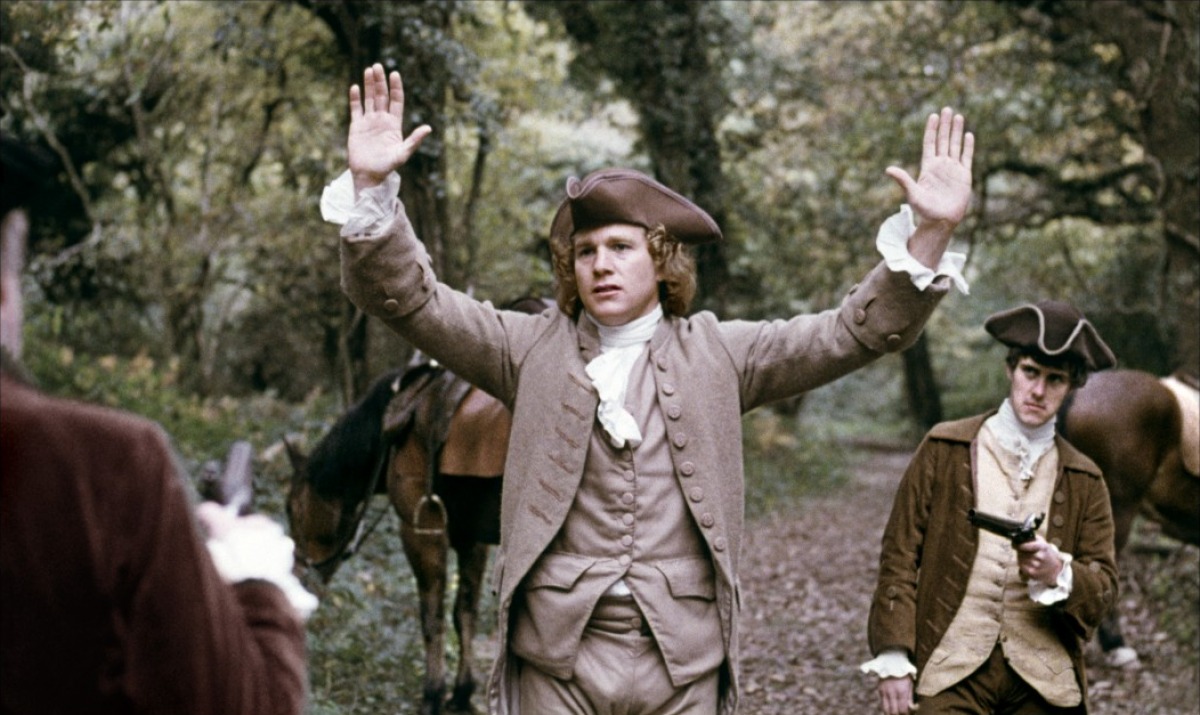
Bland Barry: An Epic about a Thoroughly Mediocre Fellow: BARRY LYNDON (Stanely Kubrick, 1975)


One of the most interesting things about Barry Lyndon is that he's boring. He's a bit stupid - but not enough for me to feel sorry for him; he's a bit pompous - but not enough for me to hate him; he's somewhat good-looking - but not enough to inevitably draw the eye; he shows some bravery - but it's a workaday sort that anyone might show; his beginnings are poor - but not too desperately poor; his end has some tragedy - but it is not terribly so (he does get to keep his knee and 500 a year).

And so the grandeur of the vehicle that carries him - an epic film - epic in length, epic in beauty and filled with wars and duels and love affairs and wealth - is perhaps the great joke: an essentially average person, someone I neither love nor hate, gets the title card.

Is Stanley Kubrick giving me a conspiratorial elbow to the ribs or a mocking grin? I am not sure if I am in on the joke or the butt of it, for while I can see the irony of the thing, I cannot, in the end, easily distance myself from it. I am uncomfortably suspicious of two things: one, that every film, every story I've ever watched or ever read is not really about a hero at all (perhaps even the idea of a protagonist is bogus); they all feature average, boring people; I've just been fooled by the accoutrements. Two, that we are each terribly average - and well, a bit boring - in spite of the central role we each feel we play in our own lives.

When presented finally at court, a title carries no real consequence, and the king, however polite, cannot really place the man with the grand title as one of those among his acquaintance and within his respect.

Barry Lyndon is only Redmond Barry after all.


Tuesday, June 9, 2015

"Let's Listen" - The House Is Black (Forugh Farrokhzad, 1963)


"Alas, for the day is fading the evening shadows are stretching. Our being like a cage full of birds is filled with moans of captivity."

This documentary, following the lives of those living in a leper colony, is the only film of Forugh Farrokhzad, a woman Iranian poet, who died at 32, only four years after making the film, but it is, at 21 minutes, spare and powerful, and it is no wonder that it is credited with sparking the Iranian New Wave.

She films as you might expect a poet to do - layering spoken verse (from the Bible, the Koran, and Farrokhzad's own poetry) with potent, select images, each image speaking volumes, some images repeated - all together creating threads of being and feeling.  At first, one feels horror - the toeless foot with scissors snipping away at dead flesh, the eyeless face, the noseless face - but horror quickly falls into sympathy and then into something more complex, something like empathy. - What is that? That is a person. That is someone like me. -

The film ends in a schoolroom of children, some adults around the edges.
"You. Name a few beautiful things," says the teacher.
The boy student pauses. "The moon, sun, flowers, playtime."
To another student, "And you, name a few ugly things."
Another pause.
"Hand. Foot. Head."
I, watching and listening, feel a shock of sympathy - in this boy's life, the human body is an ugly thing.
But, as in a gentle contradiction to my response, those in the school room do not cry.  The room erupts in laughter. Laughter. And the boy's eyes light up; he ducks his head, a sweet modesty in having unexpectedly made a joke.

Like the best kind of film, this film shows me my own failures to see and understand - and makes me see, makes me feel. And the world is suddenly much richer.

"Let's listen to the soul who sings in the desert."

Saturday, April 4, 2015

Musings on Poetry and Interstellar (Christopher Nolan, 2014)


A friend of mine - a former student and a budding poet, headed for an MFA in poetry program this fall – recently told me that the more he works his craft, the more he finds he wants to compress, the more he wants to replace an initial phrase with a single word or to replace a set of phrases with just one brief phrase. The idea is to create a work full of just a few potent words - words that contain multitudes, so to speak - instead of a work full of many less resonant ones.

What he wants to offer the reader, I think, is something like a seed, a latent, fertile thing that, when planted in the reader’s mind, germinates and expands. And his poetry, as I read each new poem he sends me, is increasing in these kinds of compression-fueled expansions. His work is, more and more, made up of compact sets of lines that feed a reader’s delight: they puzzle at first in their bold brevity – but then, as I sit with a particular poem, letting my tongue savor the sounds and my mind mull the possibilities, a meaning will open as with a sudden blooming, and then there's another, and another meaning, until the poem fills all my thoughts and feelings – and I find I have been a participant in that deeply personal discovery that readers of poetry often feel, a discovery dependent upon that unique, intimate interaction between poem and reader.

Poets like my friend understand that poetry is not really poetry if it has no reader; to even exist, it, in some sense, needs a reader, a reader willing to grasp, plant, and water those word-seeds. The poet depends on readers for the poems to live. And the reader, likewise, understands that there is very little joy in reading if the poet does not trust the reader enough to allow the reader to do the nurturing, to offer care and feeding to those seeds.

A poem, then, might be considered not as a thing on a page but as an interaction, a relationship. And the greater the trust and investment on both sides, the greater the love, the greater the joy. As Jeanette Winterson writes in her essay, “Imagination and Reality,” “Love is reciprocity, and so is art.”

But if the use of Dylan Thomas’s “Do Not Go Gentle into That Good Night,” in Interstellar is any indication, I do not think Nolan understands that about poetry: that latent fertility of a poet’s words, that need for trust between poet and reader.

And perhaps he doesn’t even understand how much the visual, sensory building blocks that make up the cinematic experience can be like those potent word-seeds we find in poetry, visual and sensory things that truly bloom only when allowed to be planted in the mind and heart of the viewer.

For Nolan does not trust that Thomas’s words contain a potency that needs no explaining, no repetition.

Nor does he trust that his own visuals will tell the story he wants to tell.

Instead, he lectures through the mouths of his characters, telling us what to think. He harangues with a deafening, ever-present score, telling us what to feel.

Virginia Woolf in her brilliant and provocative essay, “How Should One Read a Book,” writes, “The impact of poetry is so hard and direct that for the moment there is no other sensation except that of the poem itself. What profound depths we visit then – how sudden and complete is our immersion! . . . Our being for the moment is centred and constricted, as in any violent shock of personal emotion. Afterwards, . . . the sensation begins to spread in wider rings through our minds; remoter senses are reached; these begin to sound and to comment and we are aware of echoes and reflections.”

But Nolan will not let that “hard,” “direct” “sensation” of Dylan’s brilliant words or of his own visuals reach the “profound depths” they have the capacity to do. Instead of being “centred and constricted,” instead of having the joy of “sensation” “spread[ing] in wider rings through our minds,” we have only a strident bombast, and in leaving the theater, we leave with very little that is ours. No relationship has been established, no seeds have been planted in the mind and heart and allowed to grow and delight us with their secret and expansive growth.

And it’s not that every piece of writing needs to be a poem to offer satisfaction. And not every film needs to offer the subtle delight of densely resonant visuals that tell their own story, sans explicit explanation. The non-fiction essay and the pulp novel offer their own delights as does a simple genre film - a rom-com or an action flick.

But the disappointment here is that Nolan seems to believe that any move towards complexity, away from a simple genre film, necessitates lengthy, direct explanation. We do need those lengthy explanations sometimes –say, in scientific essays and political editorials. But a fiction film is neither an essay nor an editorial - and should not complexity be broached differently, so as to make full use of the unique medium of film, so as to invite the viewer into joys of the cinematic relationship?

I try to imagine what 2001: A Space Odyssey would have been had Kubrick put explanations of the monolith into the characters' mouths. Would not the thing lose its potency? As it is, that monolith sits like a provocative weight in the mind, growing in density and meaning throughout the film and in the aftermath of the film, as I sit at home or in my car and ponder. It grows in meaning and significance exactly because it's given wholly to the viewer, and the viewer must interact with it, decide what it is, what it means. And so the monolith becomes personal. It's no longer exterior to me, but it sends ever "wider rings" of resonance through my mind - and it has, indeed, taken on such resonance in so many minds since 1968, that it appears again and again in the film world and elsewhere - and is now a part of our cultural cache, a thing, as Yeats might put it, of the Spiritus Mundi , containing multitudes, containing both Kubrick and his ideas and ourselves. Nolan ought to know all that, for his use of the monolith in figures of TARS and CASE gives him no excuse not to know it. The monolith needed no explanation to be powerful – in fact, it is powerful still because it lacks direct explanation.


Total ambiguity in the realm of art is, of course, frustrating – a slosh of vague symbols with no clues as to their meaning(s) and contributing to no discernible pattern can make a reader or a viewer feel betrayed.

There is the other problem, too, that the perhaps the artist is not actually offering a complex or satisfying set of meanings and ideas, and mulling over a work from from such an artist leaves us essentially empty handed.

My friend’s poems work because they do not remain, ultimately, ambiguous, and the ideas and meanings they contain, once discerned, satisfy the intellect and heart. It’s worth it to invest myself in the poetry he sends me because I know, as a reader, I will be rewarded for my trust, for my belief that the poem is worth investing myself and my time in.

Nolan’s film avoids ambiguity (perhaps) as it layers exposition upon exposition, assuming, apparently, that the complexity of the film is too much for the viewer, but in the end, ironically, the film’s central idea seems trite and unsatisfying, very little more than a shallow sentiment about love transcending time and space.

Nolan has the skill, I think, to offer something visually, viscerally arresting and resonant. But as of yet, particularly in recent years, I am less and less rewarded as a viewer – in large part because, even if the ideas are shallow, Nolan will not give the trust to the viewer that the viewer has given to the films. There is no deeply significant interaction between filmmaker and viewer.

Winterson writes of the interaction between artist and viewer, “The exchange that art offers is an exchange in kind; energy for energy, intensity for intensity, vision for vision. This is seductive and threatening.” And then she asks, “Can we make the return? Do we want to? Our increasingly passive diversions do no equip us, mentally, emotionally, for the demands that art makes.” Winterson, here, puts the pressure on us, as art-consumers, to offer ourselves to the art, to be consumed as much as we consume – if we want to be fully rewarded by the art.

Does Nolan’s work and his level of investment in me as a viewer merit my own return? I am increasingly uncertain that the answer is, “yes.”

Saturday, January 17, 2015

FINDING VIVIAN MAIER (2014)


There's an attempt here to play up the idea of eccentricity: if a woman is single and doesn’t appear to want to marry, if she travels alone to far off places, if she travels down back alleys and to stockyards, if she wants a lock for her door, if she collects newspapers, if she takes photos of an injured person instead of standing around gawking like everyone else, if she isn’t freely open about her past, if she opts not to tell a shop-owner her name, she is deemed an oddity. And yet, I wonder, were a man to behave in the way she did, would he be called such an eccentric? Are any of those actions really so extremely erratic and bizarre?

While John Maloof claims in his film to want to make known to the world Vivian Maier’s photography, there is a queasy quality, a sort of TV tabloid element, permeating the whole endeavor, and the result is as similarly shallow as any episode of Hard Copy. Maier, as a subject, is an object to be poked and prodded and dissected; every small action or life detail that can be discovered is taken and exploded into suggestive significance. And people who clearly didn’t know her – who, for the most part, seem to think of her as a bizarre object themselves, and who seem to be quite pleased to be at the center of some attention – are paraded forth for comment.

And as pleased as the interviewees are to be on film, Maloof, himself, so constantly references his own purportedly solitary efforts to champion Maier, it is difficult to see much story here beyond his own self-interest (and as this NYT piece indicates, Maloof’s proprietary claim on Maier is dubious at best).

It is in spite of the film itself that we get glimpses of the complex human being that Maier must have been, and in those glimpses and hints, we must affirm that the irreducible complexity of Maier cannot be violated by the prods of petty filmmaking. She will not be reduced to “odd,” “eccentric,” “reclusive”; she cannot be contained by words like “spinster” or “nanny.” Her person remains hers and hers alone, locked, whole, dignified.

What remains, what transcends the film’s leering attempts at story-telling, is her photography. The images she captured invite us to engage in looking at the world in fresh ways – at beauty, tragedy, comedy, ugliness in unexpected places. And in this new looking, we turn with her, at her side, as fellow human beings, to look at the world she saw. I know nothing about her - and that is as it should be – but I am so grateful to be enriched by her eyes.


NOTE: It would be hypocritical of me not to acknowledge that I owe gratitude to John Maloof for bringing Maier to my attention in the first place: had he not made this film, I am not at all sure I would have heard of her at all. And it is on the website he curates - http://www.vivianmaier.com/ - where her photography is most extensively accessible online. I am torn: I must be grateful for the film and yet its sensibilities are galling in the extreme. 

Tuesday, January 6, 2015

The Missing Picture, a film by Rithy Panh (2013)


"How do you revolt when all you've got are black clothes and a spoon?"

How indeed, when everything is stripped from you, is there space for anything but survival - and in the surviving, what is left but grief, guilt, loss? But here, now, Rithy Panh stages his revolt, as the only means to continue living. Here, using crude clay, as if using the very stuff of his being and of the flesh of those he buried, Panh builds images of what he lost - and builds it on his own terms.

Where the Khmer Rouge had seized photos to destroy the threat of the personal and of the individual and created new films to promote political ideology and lying glory, Panh seizes images in return, taking such filmed ideology, and frames it, transforms it: adding his clay figures -much more powerful figures than the clapping, smiling Pol Pot - adding his narration - much more powerful than the screaming of slogans - and reclaims his past, his color - not black but pink, yellow, and red - his family, his story, himself. The crude clay speaks while the black and white film of the regime merely mumbles incoherently.

Still, it would be a mistake to pretend Panh is not a haunted man. There is no healing, not really, not fully, even in such powerful artistic revolt. "It's not a picture of loved ones I seek, I want to touch them. Their voice is missing," he says.

Even his own voice, in the boy he was, is lost to himself: "It's the boy; he seeks me out. He wants to speak to me, but words are hard to find."

The words, the memories, the images are hard to find, and even "Mourning is difficult. There is no end to the burial. . . . There is the blood drenched earth. Their flesh is mine, so we are together."

And so the film ends, with the burial of a clay figure - buried, being buried, being buried - and it is a figure, a picture, I cannot easily forget.

Thursday, April 17, 2014

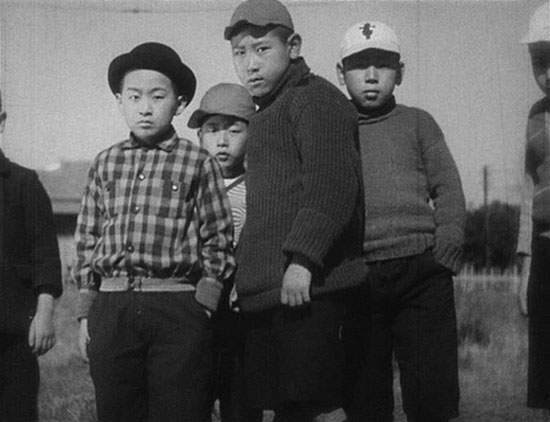
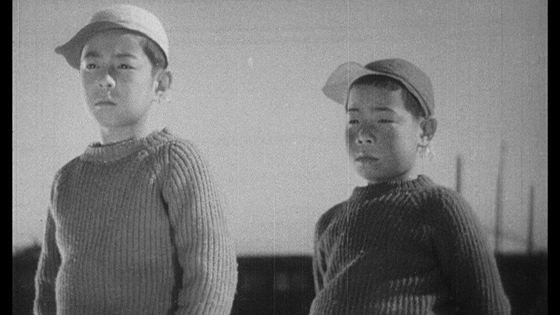
I Was Born But . . . (Yasujirô Ozu, 1932)


“Can your dads take out their teeth like my dad?”

Jostlings for superiority, shufflings for power, and contests of strength –  flurries of action that settle into hierarchies – these games are played out in the neighborhood spaces where boys vie for sparrows’ eggs and in the workspace where men vie for the biggest laugh from the boss. Who eventually becomes general, who becomes lieutenant general, and who becomes the one slain by an invisible bullet firing forth from the finger of another is as arbitrary and ridiculous as it is terribly serious.


The revelation that a father’s position relies on such arbitrary and demeaning ridiculousness disrupts two boys’ own sense of position and self. Indignant and grand, the boys – one virtuously, one reluctantly – lodge their protest, refuse their rice. Grandness can be maintained only so long though, and virtue yields to the pains of the stomach. In such acquiescence comes further revelation, or rather, more poignantly, self- recognition: the boys know that they and their father, in the end, walk in the same world, play the same games.

Is this tragedy? Is it comedy? It depends, perhaps, on one’s point of view.  Here, at any rate, Ozu’s light touch makes room for nuance, for both comedy and tragedy - and also, maybe more importantly, for tenderness. In the midst of the jostlings, the games, the indignation, and sad realizations, there is the comfort of a steaming kettle, of a parent’s affectionate gaze on a child’s sleeping face, of a plate of rice offered in peace, and of a look of understanding passed between father and son.