Showing posts with label review. Show all posts

Wednesday, November 21, 2018

Meek's Cutoff (Kelly Reichardt, 2010)


The following is a loose transcript of a presentation I gave on Meek’s Cutoff, a film that was part of the Pickford Film Center’s repertory series, West of What?!, that ran from June 2017-May 2018. The presentation included a slideshow; the images below correspond to the slideshow images.
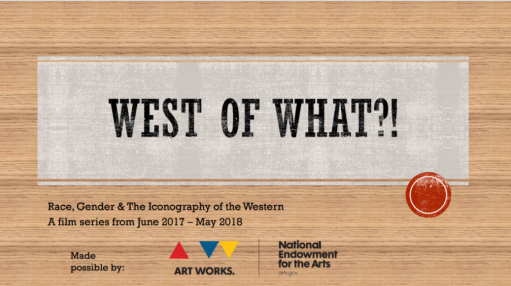
Meek

Good afternoon and welcome to the screening of the Kelly Reichardt’s 2010 film, Meek’s Cutoff.

Today’s film is a part of the Pickford’s West of What?! Westerns series, and, so before we begin the film, I’m going to talk for a little while about the film and its place in this series.

The Westerns genre is, of course, a significant part of the American cinematic landscape, and it was, for a certain period, enormously popular.


Between 1930-1954, approximately 2,700 Westerns were released. (Source: http://www.b-westerns.com/graphs.htm )

Meek's Slide 1
The Westerns genre, though, contained some troubling ideas or myths that are important to recognize.

For example,
  • The genre often promoted myths of westward expansion – the idea of Manifest Destiny – this sort of God-given right (to white people) for westward expansion into the indigenous peoples’ land.
  • It often defined a very narrow, traditional view of masculinity
  • It presented often absurd, gender stereotypes for women. Women were often depicted as purely domestic beings, side characters mostly useful as a civilizing force over men
  • It often normalized genocide, specifically of Native Americans

One of the most interesting things about Westerns is that the popularity of the genre might have a lot more to do with how many Americans tend to see and explain themselves (Looking at Movies, Barsam and Monahan), rather than with a connection to historical accuracy or to the true, often troubling, complexity of our country’s checkered history.

So one of the goals of the West of What?! series – given these things – has been to consider the problematic ideas or ideologies in the Western genre both by looking at Westerns that contain them and by looking at Westerns that subvert them in some way. 
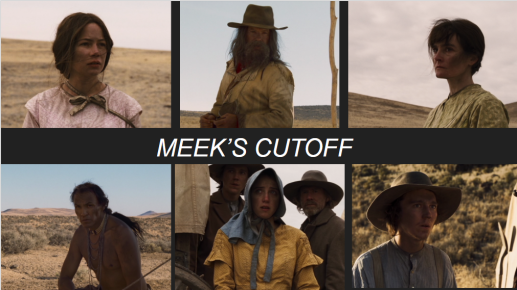

Meek's slide 3

Today’s film, Meek’s Cutoff — starring Michelle Williams, Paul Dano, Bruce Greenwood, Zoe Kazan, Shirley Henderson, Rod Rondeaux — offers a particularly interesting entry into the Westerns genre in the ways that it meets the genre conventions but also completely overturns them.

Reichardt’s film might even be conceived as a sort of answer to some of the most troubling myths of the Westerns genre, but it is also, itself, unmistakably, a Western. . . .

(Continue reading at Seattle Screen Scene: Link )

You Were Never Really Here (Lynne Ramsay, 2017)

Joe in shadow


“Where are we going?”
“Wherever you want to go. . . . Where do you want to go?”
“I don’t know.”
“I don’t know either.”


In Alfred Hitchcock’s 1960 film, Psycho, a past-haunted man cannot escape himself or the violence he has known and inflicted, and he preserves his own guilt and trauma, literally, in the body of his mother. He could not bear to live with her and the man she called her husband, and so he killed her. He could not bear to live without her, and so he keeps her, tucked in her bed, a “boy’s best friend.” It’s an impossible, stunted existence, an embalmed life, where the dead cannot be buried, and it is a life that splits Norman Bates’s identity in two. His body becomes a sort of prison, a site of ever-present struggle between two selves, between life and death, past and present. “We scratch and we claw,” Norman says, “but only at the air, only at each other, and for all of it, we never budge an inch.”

Lynne Ramsay’s newest film, You Were Never Really Here, beautifully recalls this earlier cinematic classic both overtly and obliquely. Joe (Joaquin Phoenix) is a war veteran, a sort of walking dead man like Norman Bates. Joe carries the suffocating horror of his past around in his scarred body while violent images of that past crash, unbidden, into his mind, disrupting his path in any given moment. The voices of the dead, too, and of his younger self force themselves into his ears. His is a divided existence, and his body contains a mind that won’t obey him. “What am I doing?” he mutters to himself when one of these images or voices shatters his attention and a task at hand. He is often, then, cut off from the world around him, the trauma of his mind wrenching him towards itself and away from an exterior, Other reality.

While Ramsay gives us stark, brutal reminders, often in close-up, of the solidity of Joe’s body, a body that has suffered or is suffering, Joe is, still, a faltering being, a kind of traveler who can’t find a home. His very image flickers in front of us as vehicles rush past in the foreground of the frame and we strain to see him in the background, beyond the rush of street traffic. And even the thin sound of shrieking train wheels and the low rumblings of the cars on a highway which fill the world of the city in which Joe walks are sounds that seem extensions of the constant clamoring in Joe’s mind. Ramsay, as she has done previously, particularly in We Need to Talk About Kevin, fills the world of the film with images and sounds that constantly challenge our sense of reality; we question, at turns, what we see and hear since our protagonist’s traumatized, fractured mind shapes the story. Other damaged and waiting travelers slide in and out of the frame of Joe’s world; they are perhaps the only kind of world he can see through the lens of his experience: figures seated with patiently impassive faces at a station, a sleeping man in a hotel lobby, the bruised face of a woman by the train, a blank-faced woman lifelessly draped across chairs at the airport. . . .

Continue reading at Seattle Screen Scene: Review

Wednesday, April 19, 2017

August 2016-February 2017: My reviews for Seattle Screen Scene

The Lure (Agnieszka Smoczynska, 2015): Review


Ixcanul (Jayro Bustamante, 2015): Review


Kensho at the Bedfellow (Brad Raider, 2016): Review


Our Little Sister (Hirokazu Kore-eda, 2015): Review 
(full review, updated and expanded from the earlier capsule review)


Monday, July 25, 2016

April-June 2016: My reviews for Seattle Screen Scene

Knight of Cups (Terence Malick, 2015): Review 


Louder Than Bombs (Joachim Trier, 2015): Review


Our Little Sister (Hirokazu Kore-eda, 2015): Capsule review


Long Way North (Remi Chaye, 2015): Review


Under the Sun (Vitaly Mansky, 2015): Capsule review


Sunset Song (Terence Davies, 2015): Review


Neon Demon (Nicholas Winding Refn, 2016): Review


Swiss Army Man (Dan Kwan & Daniel Scheinert, 2016): Review


Wednesday, March 23, 2016

Text and Self: The Clouds of Sils Maria (Olivier Assayas, 2014)


"The text is like an object. It's going to change perspective depending on where you're standing."

And as the director, Klaus Diesterweg (played by Lars Eidinger), tells the journalist, the experience of the play, Maloja Snake, will be different for every audience member, each bringing his or her own personal subjective weight to bear on that elusive textual object.

So, I have to ask, would this film have played differently for me were I 20-something, instead of 40-something? Would I, perhaps, be more interested in Valentine (Kristen Stewart) or Jo-Ann (Chloë Grace Moretz), than Maria Enders (Juliette Binoche), a woman confronted by youth - as something startlingly distant from herself - at every turn? I am drawn to Valentine, particularly, of course, and Stewart's performance is as good as they say, but in her, I am startled, like Maria, to see a projection of what I thought I was, not what I am.

I am confronted, week to week, in my capacity as a professor, by 17-22 year old college students, living a moment in their lives that I remember so vividly: that passion for new ideas, that excitement in throwing off perceived tradition, that confident sense of self and one's own "barbaric yawping." For them, the Transcendentalists make the most sense: "Trust thyself"? Of course. "Speak the rude truth"? What other way of speaking can there be? "Absolve [me] to [my]self"? Oh, yes, indeed, they know they shall "have the suffrage of the world."

It is, truly, a thrill to watch such bold living and speaking, but there is, too, as time crawls every more quickly on, an increasingly bitter sting at the end of each quarter, when these bold young beings leave me without a backward glance. Some, it is true, stop to thank me, to wish me goodbye, but most do not think the life of a 40-something professor is truly of much interest - not with their own lives, stretching before them. They simply cannot imagine what mine is and can't really care. And it is right that it should be so. I cannot, as Maria does of Jo-Ann, ask them to pause, for just a few seconds more, as they walk out the door. The poignancy in those seconds would be only for me. No, it is a "little life," after all, "rounded with a sleep," and I see, more and more, as only one of the "players," I cannot take more than my fair share of "exits and . . . entrances."

I am not of their moment, not anymore. Someday, they shall be in mine though that is not really a thought that brings much comfort. They, surely, just as I am now, will be looking backwards to their own youth, not forwards to wherever I am.

Maria, so viscerally and vulnerably performed by Binoche, for me, then, embodies, with an almost unbearable truth, something of the journey of age I feel and resist and give in to and resist and give in to every day, the "rag[ing] against the dying of the light" and the sighing in acquiescence taking almost equal turns. She is someone learning that the narrative isn't really about her - or at least, it is her narrative, she is in it, but her part may not be very important to anyone else. She may cry out in excited questioning, as the rolling clouds and mist stream into the distant valley, "Is that the Snake? Is that the Snake?" but as she turns to the expected audience, she'll find no one is watching, no one listening. Only the still, looming mountain remains, unmoved by the little drama.

I wonder. Next time I watch this, will Rosa Melchior, mostly off-stage, forgotten by most, be the figure who inhabits my mind?