Thursday, August 22, 2019

Madonnas and whores and white racial innocence: An examination of ONCE UPON A TIME IN . . . HOLLYWOOD (Quentin Tarantino, 2019)


**SPOILERS THROUGHOUT**


I. Prolegomenon: “Once upon a time,” Conservatism, and the Appeal of Nostalgia


This isn’t a review. It isn’t a judgment about whether a film is good or bad at a filmmaking level. Rather, it’s an attempt at a primarily thematic analysis. It’s an effort to answer some questions I have.

I want to consider Quentin Tarantino’s Once Upon a Time in . . . Hollywood on two levels: 1) a thematic one, specifically focusing on its construction of, assumptions about, and implications about gender and race — though, as a white person, I am more uneasy about tackling this one, aware that my own complicity in whiteness will always cloud how I observe and understand race on screen — and 2) an emotional one, arguably difficult, subjective territory, but one I think I have to address, given my own overwhelming fury upon exiting the cinema after my first viewing of the film.

First, then: what is the film saying or implying about gender? About men and about women? I believe Once Upon a Time in . . . Hollywood is, in essence, a conservative film. (And I credit my friend Ben Hynes for using this adjective in reference to the film in a conversation with me and thus, as aptly chosen words often do, doing much to illuminate and organize the clutter of details in the film I’d observed.) And by “conservative” I mean two things: first, a conservative stance is one that is, inevitably, backward looking. It looks to the past as a guide for the future and understands or uses the past to measure the present, which generally fails to measure up. A conservative viewpoint on some level idolizes the past — better days, better times, the good old days. It is inherently nostalgic. Second, the film is conservative in the sense that it not only looks to the past with longing, but it is itself rooted in what I would generally consider (particularly as relative to a “liberal” or “progressive” viewpoint) outdated, regressive understandings of the world and, more fundamentally, of the way the world should be. . . .

. . . Read the rest over at Seattle Screen Scene: here

Wednesday, November 21, 2018

Meek's Cutoff (Kelly Reichardt, 2010)


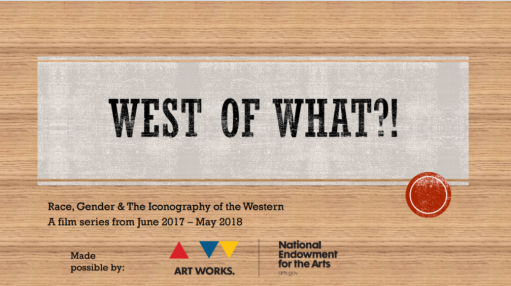
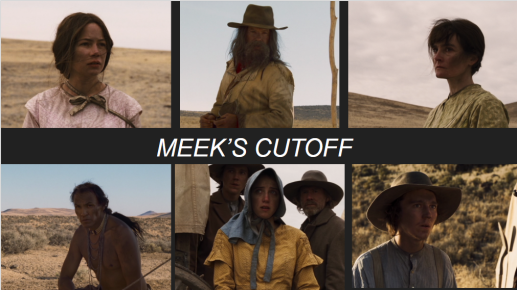
The following is a loose transcript of a presentation I gave on Meek’s Cutoff, a film that was part of the Pickford Film Center’s repertory series, West of What?!, that ran from June 2017-May 2018. The presentation included a slideshow; the images below correspond to the slideshow images.

Meek

Good afternoon and welcome to the screening of the Kelly Reichardt’s 2010 film, Meek’s Cutoff.

Today’s film is a part of the Pickford’s West of What?! Westerns series, and, so before we begin the film, I’m going to talk for a little while about the film and its place in this series.

The Westerns genre is, of course, a significant part of the American cinematic landscape, and it was, for a certain period, enormously popular.


Between 1930-1954, approximately 2,700 Westerns were released. (Source: http://www.b-westerns.com/graphs.htm )

Meek's Slide 1
The Westerns genre, though, contained some troubling ideas or myths that are important to recognize.

For example,
  • The genre often promoted myths of westward expansion – the idea of Manifest Destiny – this sort of God-given right (to white people) for westward expansion into the indigenous peoples’ land.
  • It often defined a very narrow, traditional view of masculinity
  • It presented often absurd, gender stereotypes for women. Women were often depicted as purely domestic beings, side characters mostly useful as a civilizing force over men
  • It often normalized genocide, specifically of Native Americans

One of the most interesting things about Westerns is that the popularity of the genre might have a lot more to do with how many Americans tend to see and explain themselves (Looking at Movies, Barsam and Monahan), rather than with a connection to historical accuracy or to the true, often troubling, complexity of our country’s checkered history.

So one of the goals of the West of What?! series – given these things – has been to consider the problematic ideas or ideologies in the Western genre both by looking at Westerns that contain them and by looking at Westerns that subvert them in some way. 


Meek's slide 3

Today’s film, Meek’s Cutoff — starring Michelle Williams, Paul Dano, Bruce Greenwood, Zoe Kazan, Shirley Henderson, Rod Rondeaux — offers a particularly interesting entry into the Westerns genre in the ways that it meets the genre conventions but also completely overturns them.

Reichardt’s film might even be conceived as a sort of answer to some of the most troubling myths of the Westerns genre, but it is also, itself, unmistakably, a Western. . . .

(Continue reading at Seattle Screen Scene: Link )

You Were Never Really Here (Lynne Ramsay, 2017)

Joe in shadow


“Where are we going?”
“Wherever you want to go. . . . Where do you want to go?”
“I don’t know.”
“I don’t know either.”


In Alfred Hitchcock’s 1960 film, Psycho, a past-haunted man cannot escape himself or the violence he has known and inflicted, and he preserves his own guilt and trauma, literally, in the body of his mother. He could not bear to live with her and the man she called her husband, and so he killed her. He could not bear to live without her, and so he keeps her, tucked in her bed, a “boy’s best friend.” It’s an impossible, stunted existence, an embalmed life, where the dead cannot be buried, and it is a life that splits Norman Bates’s identity in two. His body becomes a sort of prison, a site of ever-present struggle between two selves, between life and death, past and present. “We scratch and we claw,” Norman says, “but only at the air, only at each other, and for all of it, we never budge an inch.”

Lynne Ramsay’s newest film, You Were Never Really Here, beautifully recalls this earlier cinematic classic both overtly and obliquely. Joe (Joaquin Phoenix) is a war veteran, a sort of walking dead man like Norman Bates. Joe carries the suffocating horror of his past around in his scarred body while violent images of that past crash, unbidden, into his mind, disrupting his path in any given moment. The voices of the dead, too, and of his younger self force themselves into his ears. His is a divided existence, and his body contains a mind that won’t obey him. “What am I doing?” he mutters to himself when one of these images or voices shatters his attention and a task at hand. He is often, then, cut off from the world around him, the trauma of his mind wrenching him towards itself and away from an exterior, Other reality.

While Ramsay gives us stark, brutal reminders, often in close-up, of the solidity of Joe’s body, a body that has suffered or is suffering, Joe is, still, a faltering being, a kind of traveler who can’t find a home. His very image flickers in front of us as vehicles rush past in the foreground of the frame and we strain to see him in the background, beyond the rush of street traffic. And even the thin sound of shrieking train wheels and the low rumblings of the cars on a highway which fill the world of the city in which Joe walks are sounds that seem extensions of the constant clamoring in Joe’s mind. Ramsay, as she has done previously, particularly in We Need to Talk About Kevin, fills the world of the film with images and sounds that constantly challenge our sense of reality; we question, at turns, what we see and hear since our protagonist’s traumatized, fractured mind shapes the story. Other damaged and waiting travelers slide in and out of the frame of Joe’s world; they are perhaps the only kind of world he can see through the lens of his experience: figures seated with patiently impassive faces at a station, a sleeping man in a hotel lobby, the bruised face of a woman by the train, a blank-faced woman lifelessly draped across chairs at the airport. . . .

Continue reading at Seattle Screen Scene: Review

Friday, October 20, 2017

Top of the Lake: China Girl (Jane Campion, 2017)


Jane Campion’s most recent project, Top of the Lake: China Girl, a follow-up to Top of the Lake (2013), is a 6-hour, episodic journey that premiered, variously, at Cannes, on the Sundance channel, and, played, most recently, at the Vancouver Film International Festival. It is, as its length and as its screening venues suggest, difficult to pin neatly into a category. Is it a gorgeously shot TV show? A very long film? Campion and her work, as usual, resist tidy classifications of all sorts.


Does her work represent “female annihilation in bonnets,” as BBC Radio 5 film critic Mark Kermode once suggested, or is she definitely a feminist director, her work “emphasiz[ing] and almost perverse figuration of female strength” as Professor of Film Studies at University of East Anglia, Yvonne Trasker has said? Campion herself has championed women and women filmmakers, quoted as saying in an 1993 Cahiers du Cinema piece, “I think I know things about women that men cannot express.” And yet she “bridles” Virginia Wright Wexman notes in Jane Campion: Interviews, “at being narrowly identified as a feminist filmmaker,” and Wexman cites Campion as saying, “‘I think it’s quite clear in my work that my orientation isn’t political or doesn’t come out of modern politics.’”


Ultimately, it’s Campion’s work’s resistance to all kinds of categories, feminist and otherwise, that thrills me most. She does feature vibrant, strongly characterized women and female relationships in all of her films – sisters, mothers, daughters, friends – but her women are messy, often complicit in their own oppression, often loving men that oppress them. She often, too, defines, examines, and explores the patriarchal structures that surround her female characters, exposing those structures as destructive and abusive, and yet her men are messy, too, rarely simply openly misogynist without also being one some level complex and sympathetic. . . . 


Read the rest over at Seattle Screen Scene.

24 Frames (Abbas Kiarostami, 2017)


The frame holds me.
Straining to see beyond,
I sleep,
caught between
tension & peace.


In the sleep, I dream,
The dream, a window
into what is
and what could be.

     –(Adapted from the original tweet, 9/29/2017)


An inevitable sort of melancholy hangs over a beloved filmmaker’s last film, and one feels a certain pressure to love it, whatever it is. Going into the screening of the final film of Abbas Kiarostami (1940-2016), 24 Frames, I couldn’t ignore the nostalgia associated with the endeavor. I am not sure, ultimately, if it will ever be possible for me to disassociate the film from the cinema experience of sitting in the dark, grieving a film lover’s grief and thinking, “This 120 minutes will be the last new footage I will ever see.” But sitting there, even so intensely aware of the experience as a memento mori, Kiarostami’s film–flickering relentlessly forward through those precious minutes–took on its own weight. Like all of his films have done for me, it slowly removed me from self-consciousness and immersed me in itself.


24 Frames is certainly unique within Kiarostami’s oeuvre. It’s the sort of thing you might expect to find in an exhibition at the MoMA, where you can study an art piece for a while and then wander away. It’s not the sort of thing you’d expect to sit in the dark and watch for two hours. But then, Kiarostami has always been playing with the idea of cinema, his films so often reflecting back on themselves and on the act of filmmaking, and in these reflections, he has continually made his audiences consider again what cinema is and what it could be. . . . 


Read the rest over at Seattle Screen Scene

Landline (Gillian Robespierre, 2017)


Early in Gillian Robespierre’s new film, Landline, Dana (Jenny Slate), compulsively scratching a poison ivy rash contracted in a not-so-romantic encounter in the woods with her fiancé, sits across a desk from a co-worker discussing their dates from the previous night. Effusively, the co-worker describes a romantic, hours’ long “epic conversation on the rooftop.” Dana, pausing, responds that she and her fiancé, in contrast, had spent “three hours at Blockbuster.” “We got Curly Sue,” she adds. It’s the kind of specific, funny, and evocative moment that punctuates and defines Robespierre’s work, a moment that deftly situates us in the time and space of the film’s 1995 setting, in a character’s emotional landscape, and in the thematic framework. . . .

Read the rest over at Seattle Screen Scene.

Wednesday, April 19, 2017

August 2016-February 2017: My reviews for Seattle Screen Scene

The Lure (Agnieszka Smoczynska, 2015): Review


Ixcanul (Jayro Bustamante, 2015): Review


Kensho at the Bedfellow (Brad Raider, 2016): Review


Our Little Sister (Hirokazu Kore-eda, 2015): Review 
(full review, updated and expanded from the earlier capsule review)


Monday, July 25, 2016

April-June 2016: My reviews for Seattle Screen Scene

Knight of Cups (Terence Malick, 2015): Review 


Louder Than Bombs (Joachim Trier, 2015): Review


Our Little Sister (Hirokazu Kore-eda, 2015): Capsule review


Long Way North (Remi Chaye, 2015): Review


Under the Sun (Vitaly Mansky, 2015): Capsule review


Sunset Song (Terence Davies, 2015): Review


Neon Demon (Nicholas Winding Refn, 2016): Review


Swiss Army Man (Dan Kwan & Daniel Scheinert, 2016): Review


Wednesday, March 23, 2016

Text and Self: The Clouds of Sils Maria (Olivier Assayas, 2014)


"The text is like an object. It's going to change perspective depending on where you're standing."

And as the director, Klaus Diesterweg (played by Lars Eidinger), tells the journalist, the experience of the play, Maloja Snake, will be different for every audience member, each bringing his or her own personal subjective weight to bear on that elusive textual object.

So, I have to ask, would this film have played differently for me were I 20-something, instead of 40-something? Would I, perhaps, be more interested in Valentine (Kristen Stewart) or Jo-Ann (Chloë Grace Moretz), than Maria Enders (Juliette Binoche), a woman confronted by youth - as something startlingly distant from herself - at every turn? I am drawn to Valentine, particularly, of course, and Stewart's performance is as good as they say, but in her, I am startled, like Maria, to see a projection of what I thought I was, not what I am.

I am confronted, week to week, in my capacity as a professor, by 17-22 year old college students, living a moment in their lives that I remember so vividly: that passion for new ideas, that excitement in throwing off perceived tradition, that confident sense of self and one's own "barbaric yawping." For them, the Transcendentalists make the most sense: "Trust thyself"? Of course. "Speak the rude truth"? What other way of speaking can there be? "Absolve [me] to [my]self"? Oh, yes, indeed, they know they shall "have the suffrage of the world."

It is, truly, a thrill to watch such bold living and speaking, but there is, too, as time crawls every more quickly on, an increasingly bitter sting at the end of each quarter, when these bold young beings leave me without a backward glance. Some, it is true, stop to thank me, to wish me goodbye, but most do not think the life of a 40-something professor is truly of much interest - not with their own lives, stretching before them. They simply cannot imagine what mine is and can't really care. And it is right that it should be so. I cannot, as Maria does of Jo-Ann, ask them to pause, for just a few seconds more, as they walk out the door. The poignancy in those seconds would be only for me. No, it is a "little life," after all, "rounded with a sleep," and I see, more and more, as only one of the "players," I cannot take more than my fair share of "exits and . . . entrances."

I am not of their moment, not anymore. Someday, they shall be in mine though that is not really a thought that brings much comfort. They, surely, just as I am now, will be looking backwards to their own youth, not forwards to wherever I am.

Maria, so viscerally and vulnerably performed by Binoche, for me, then, embodies, with an almost unbearable truth, something of the journey of age I feel and resist and give in to and resist and give in to every day, the "rag[ing] against the dying of the light" and the sighing in acquiescence taking almost equal turns. She is someone learning that the narrative isn't really about her - or at least, it is her narrative, she is in it, but her part may not be very important to anyone else. She may cry out in excited questioning, as the rolling clouds and mist stream into the distant valley, "Is that the Snake? Is that the Snake?" but as she turns to the expected audience, she'll find no one is watching, no one listening. Only the still, looming mountain remains, unmoved by the little drama.

I wonder. Next time I watch this, will Rosa Melchior, mostly off-stage, forgotten by most, be the figure who inhabits my mind?


Wednesday, January 6, 2016

Mustang (Deniz Gamze Ergüven, 2015)


“Are you afraid?” said the North Wind.
“No!” she wasn’t.
                –“East of the Sun and West of the Moon”
It might be tempting to read Deniz Gamze Ergüven’s beautifully confident feature film debut, Mustang (France’s official entry to the Academy Awards), exclusively as a portrait of the situation women face in Turkey today.  The situation, while it should  continue to concern those interested in in women’s rights , however, is too complex to be contained by a film that traces the story of one family of daughters in one part of Turkey, and I do not believe Erguven’s film should be, or is even intended to be, reduced to an examination of the particular issues faced just by women in the filmmaker’s own country, however much the story is, in fact, inspired by her experiences there and by her concern for Turkish women. She has noted  for example, that the inciting incident at the film’s beginning is one very similar to an episode in her own childhood, and she has also said that she “put many . . . stories that I heard in Turkey into the film.”
So while the film is, certainly, culturally specific in significant ways, it reads more as a fairy tale or a folk tale than as a slice of life story.  As such, its themes resonate as much for me, an American woman, as they might for anyone. Folk tales invite us to consider direct applications for the readers, and here, viewers might do the same, apply and identify. The five sisters at the center of the story and living at the edge of the Black Sea are very much like the sisters you might find in the Norwegian tales of East of the Sun and West of the Moon  collected by Peter Christen Asbjørnsen and Jørgen Engebretsen Moe, a book, gorgeously illustrated by Kay Nielsen, that I grew up with and pored over, and, embracing any hints of fantastical Other, identified with.
Though I am the eldest and only daughter in a family of four, somehow, the tales spoke to or into my sense of self, idealized or real. I had no sisters, but the sisters of, say, the tale of “The Three Princesses in the Blue Mountain” seemed to represent some version of the closeness I felt with other girls, particularly, my best friend, and she and I imagined perilous adventures for ourselves that mirrored those the sisters faced in the hall of the trolls. Our hair, too, was long in those days; we even competed about whose hair was the longest and practiced the best ways of brushing it so that it shone most, but in play, that hair was tangled and unheeded; at the height of an adventure, what did it matter, after all? By our wits and our stout hearts, not our beauty, we’d escape the evil orphanage and make our way through Dinosaur Island to safety, muddied and triumphant.
The sisters of the Blue Mountain, with the long hair and bravery we imitated, are akin, then, to the sisters in Mustang, though the sisters in the Norwegian tale find a happy ending in marriages, and, in direct contrast, it is marriage –and the cultural, restrictively gendered assumptions that surround it – by which the Turkish sisters find themselves specifically pinioned.  Marriage, here, is no happy end; it is a complex threat to identity. . . .
To continue reading, please see the full review at Seattle Screen Scene: Mustang review, Seattle Screen Scene 

Saturday, November 14, 2015

A Summer at Grandpa's (Hou Hsiao-hsien, 1984)


This inspiration for Hayao Miyazaki's My Neighbor Totoro is a total delight.

Hou builds a space in which a world from a child's perspective is at once baffling and sad and exuberantly joyous: it struggles to comprehend a sick parent who cannot leave a bed but rejoices in all-consuming splashing play by the river.

It is a perspective that sees, in one moment, only the minutest of details, and in another, feels lost in a vast world. Food remnants, left by untidy, unheeding adults litter the floor of the train, but that focused, compact space of a set of train seats is suddenly a bewilderingly large expanse when the adults are absent.

Time speeds by in the morning, while turtle races absorb hands and eyes, but seconds tick interminably in the long afternoon, loose limbs lazing on the floor of a hot room.

Family is everything, dictating life's motions and providing the structure, comfort, love, but adults are capricious, mysterious creatures. Why does Grandma weep as she folds the clothes, and why does Grandpa chase away Uncle one moment and give him money the next? One can only stare, wonder, and shrug. That's Grandma. That's Grandpa. And it's nice, anyway, to sit with Grandpa and look at those old pictures while the sound of the phonograph plays its scratchy tunes.

And so, Hou's sense of space and perspective draws me in, and even when the summer comes to a close, and with the children, I am, perhaps, ready to go home, back to the routine of life, I cannot help but feel that sweeping vistas of the green paddy fields, the rush of the train just outside grandpa's window, the place on the landing where everyone's shoes snuggled against one another, have left an imprint on the mind and heart, much like those long magical summers of my own childhood have done for me. I can never go back to the time, but it remains, like a still center at the core of something that is me.

Friday, November 6, 2015

In the Mood for Love (Wong Kar-wai, 2000)

Also reviewed at Seattle Screen Scene.


"I cannot see what flowers are at my feet,
 Nor what soft incense hangs upon the boughs,
But, in embalmed darkness, guess each sweet"
              ~John Keats, "Ode to a Nightingale"

Time shifts and slips, and the past is a thing of soft veils and refracted reflections, three of you, two of me, then none, only the round white face of the clock and the sound of your voice, my voice. I can't reach you there, at the edges of my mind; you slip from view.

But in the now, a sudden scent presses the bright deep color of your dress, the shape of your hip, a white clasp at the dip in your neck, into my vision, filling it. A green dress with bright yellow daffodils, impossibly vivid. Could you have been so beautiful? 


The streets of the teeming city were empty then, only you and I were there, there in the rain, under the bulb, there in the passage on the stairs. Our shadows pass along those walls, where paper notices tatter, fade, and are smoothly absorbed into the place on which they were glued. The rain soaks us, pounds the pavement; water seeps down into the earth, the water stands in clear pools. At once, it disappears, leaving blackness; it reflects, leaving shimmers of light.

I can feel the press in the hallway, packed with furniture, movers. Was it there I first felt the press of your arm? Or in the cab? Your fingers slip out of my grasp, leaving their warm fading print.

I wait for you. You wait for me. Memory, shrouded and alive, floats in red, graceful curtains in the long deserted passage.

I whisper this fleeting, lingering thing into the ancient ruins, where boldly soaring arches and disintegrating figures in stone relief, settle into the earth, growing into the grass and mud.


Friday, October 16, 2015

VIFF 2015: The Assassin (Hou Hsiao-hsien)


Hou Hsiao-hsien structures his new film, The Assassin, as a sort of once upon a time tale. It begins with narration, a mix of the historical and the mythic, and I am at once immersed in a dream-like tale that will, indeed, haunt my memory, just as history and myth so often do, becoming reference points in my present, even when I am not consciously aware of their influence.

It is ninth century China, and political struggle infects the kingdom. The royal court fears a strong, militarized outer province, Weibo; too much delegated power is a threat to the court’s own strength. Weibo, with a century of nearly complete self-governance, fears a reduction in its autonomy. It is a struggle that absorbs everyone.

And yet within this kingdom, there is a mother who tells another story, the story of a single bird. Caged and alone, the bird sits silent, a small stranger in the human world around it, unable to sing to those so unlike itself. Its human keepers feel compassion for it and give it a mirror. Recognizing something like itself, it sings a song of sadness. It dances, and then it dies.

In this once upon a time kingdom, there is one woman (played alternately with beautiful stillness and incisive action by the wonderful Shu Qi), caught in the midst of a large world she cannot control, a world that has named her its assassin and imprinted upon her its own mission, denying her her own world. She dances an assassin’s dance with a swift grace that leaves me breathless, but her sweet, sad face is the print left on the mind and heart.

. . .

Read my full review on Seattle Screen Scene.


Wednesday, October 14, 2015

VIFF 2015: Domestic Intimacies: Ixcanul (Jayro Bustamante, 2015) and 45 Years (Andrew Haigh, 2015)


(To read the full version of this essay, go to Seattle Screen Scene.)

Preface:
Human, and faced with a sea of things, images, stories, characters, all bobbing this way and that, slipping and sliding away from me, I seek some rope to grasp, a line that might form for me a connection between the things. And if I can only pull that line taut, I might be able to stay above the waves and see a pattern in the flotsam.

It isn’t really flotsam, of course, that wave of films I found my fest-inexperienced self submerged beneath at this year’s Vancouver International Film Festival. Each film in itself is a unique, individual thing, only forced, by necessity into a mass. And we should be used, in any case, to consuming art in the mass, collective form – in a museum, in an anthology – curated and then presented to us as somehow related objects. Even if we pick our way through an anthology or skip rather guiltily past the 13th century wing of the museum and make straight for the Impressionists, we are still aware of all of these disparate things gathered together under an umbrella of a particular Thing, and, invited to do so, the pattern seeking mind all the more eagerly links themes, ideas, modes, shapes, colors.

Artists, of course, do not live in a vacuum, and their works may be, certainly, drawing from other works, even without conscious intent. Still, it would be difficult to say 8th century Chinese landscapes were drawing any influence from Byzantine frescoes. And yet, place such a set of landscapes next to a few frescoes, I’d surely spot a pattern. I can’t help it; I put them together, and the one will converse with the other.

And so, while yet understanding the potential folly of such conjunctions and conversations, I can’t help but make them and hope that such a convergence will illuminate the individual objects themselves.

Jayro Bustamante’s Guatemalan film, Ixcanul, has very little in common with Andrew Haigh’s thoroughly British film, 45 Years, and yet, as the VIFF programming gods would have it, I saw them back to back on a Saturday afternoon early this October, and they nestle comfortably together in my mind, chapter 1 and chapter 2 in a little anthology of Domestic Intimacies.


Chapter 1: Ixcanul

Ixacanul opens on a young woman’s passive form and impassive face. Her name is Maria (María Mercedes Coroy), and her mother (María Telón) dresses her and then smooths, parts, and plaits her hair, securing a crown-like garland upon her head. The two Mayan women, alone together in their home, near a volcano, an ixcanul, in a remote region of Guatemala, both absorbed and silent in the exclusive intimacy of their shared activity, indicate that they inhabit a world with which they are familiar, and I am not. I guess, as I first look at them, that Maria is not quite happy to be so taken in hand by her mother – or perhaps she is not quite happy with the event, unknown as yet to me, for which she is being prepared.

. . . the heart of the film is with Maria and her mother, and the little domestic space they occupy, the close – if sometimes fraught – relationship they share. Maria’s maturation, the politics of the world take on resonance only because we are so thoroughly invested in the connection between these two women. We live with them through their daily chores, in the activities of farm life, of cooking and of baking, of devotion to their volcano god. In one scene, Maria and her mother set up a mating between their pigs. “Come on; let’s get her pregnant,” says the mother to her daughter, and the women, working quietly with the squealing pigs, expertly ply the rum to the pigs’ eager mouths, and the job is done. In another scene, the women visit a steaming volcanic spot of earth, and the prayers of the mother for her daughter, “Earth, wind, fire, volcano,” she recites, are evidence of another intimate routine. And then, in the night, the firelight of an open fire flickers over the faces of Maria and her mother, as they stir and stir a boiling vat. “Don’t stop; it will burn,” the mother chides, and Maria obediently moves more quickly. Daytime, and the women walk together, bundles of sticks casually balanced on their heads, moving easily through the landscape, gray volcanic rock, blond grass. Through all these tasks, so obviously familiar to them both, the two work in easy intimacy. Maria, we understand, is under the pressures of individual desires and shy quests for freedom, but always returns to her mother’s side, her mother’s protection. Cooking, bearing wood, bathing, butchering – all these things the women do together – and when Maria’s life reaches a crisis point, it is to her mother she turns, and it is the mother whose strong arms competently, passionately cradle her.

The film ends with the same shot, the same moment with which it began, Maria and her mother and the plaiting and crowning of the hair, but the scene has expanded and deepened. They reside within a relationship of long-standing patterns and behaviors, knowing one another and being known, a small circle of closeness into which I can now see. I understand the activity of the women, I understand something of what is on Maria’s face. I understand what she is to her mother and what her mother is to her, and when the pulling fingers catch for a moment on a snag of hair and then slide free, my own breath catches in a snarl of emotion.

It is the small gestures that cinema, perhaps like no other art, has the power to fill with meaning, and the gestures here, embedded in the small and domestic, ripple outward in waves of resonance.


Chapter 2: 45 Years

Andrew Haigh’s 45 Years similarly, traces the gestures of the domestic life in such a way that in his story, too, they reverberate, growing only stronger the smaller they are. The film’s first shot is the shot of a house, downsized by the frame of the landscape but centered, a clear, if gentle, demand on the attention. It is a classic sort of house you might find in an English village, modest, but firm; it knows who and what it is without drawing undue attention to itself. It is, though, essentially a blank. It could be anyone’s home. But, like the first mysterious image in Ixcanul, 45 Years makes the meaning of its first image over the course of the film in such a way that, when the image of the house – in the same framing – is repeated near the end, that meaning is, almost unbearably, full.

At the center of the house is a relationship, a thing representing an accumulation of days and of small interactions, and the house and the relationship reside at the center of the film, building significance from the inside out: an offered cup of tea, the antiphonal low humming of two voices, two bodies moving easily around one another in a cramped bathroom, quiet chats in bed that begin simply, without preface. This is what the space of 45 years of married life together looks like, feels like, for Kate (Charlotte Rampling) and for Geoff (Tom Courtenay).

. . . Kate and Geoff’s daily routine, examined over the film’s week – a Monday, Tuesday, Wednesday, Thursday, Friday, and a Saturday – struggles to maintain itself under the pressure of this stranger, and the strain of the pressure plays out within the small interactions between the couple. They are interactions that, from a distance, seem a part of a daily routine, but situated as we are, inside the circle of the home, so intently watching Geoff’s face or Kate’s face, small differences are earthquakes. Geoff smoking a cigarette. Geoff’s note, “I’ve taken the bus to town. Sorry.” Kate’s choice to stay in bed rather than go for her morning walk. Geoff’s choice to go with Kate on her morning walk, rather than stay home. Kate smoking a cigarette. These things, potentially, shatter. Small in themselves, they deviate ever so slightly from the quotidian norm, and a whole world shifts. Who Geoff is, who Kate is, and who they are to each other becomes a fragile thing. It may break in a puff of air.

A 45-year anniversary celebration for the couple closes out the film. It is a grand gesture, and for Kate and Geoff, from within their realm of small intimacies, it feels very grand indeed. They are not sure they should participate in such a thing at all. But they do, and its grandness brings all of its weight to bear on a newly brittle center. A week is a short time, but it is a long time to live with a home intruder, and the question of what of the marriage is after this long week, is the question to which the film inexorably leads.

The answer is the answer we might expect from the world Haigh has given us with Geoff and Kate: intimate, delicate, and complex. Were we outsiders to this world, we would miss it. Insiders though, we see: a tiny thing of dense, compacted import. Taking it in, I am, myself, in danger of breaking.

Tuesday, September 29, 2015

Vancouver International Film Festival 2015, Sept. 25-26

The films I've seen so far, favorite to least favorite:


Arabian Nights: Volume 1, The Restless One (Miguel Gomes, 2015)
Meta-texture exploded, stories, storytellers, tellings, interpretations. The cockerel crows, and we listen.

Inspired by the classic Arabian Nights, Gomes reflects on the socio-political situation of Portugal in 2014, by telling stories of his own - parables of sorts, though less direct - and layering story within story, and employing everything from magical realism to biting satire. Delightful, hilarious at times, and potent.


Right Now, Wrong Then (Hong Sang-soo, 2015)
Narrative folded back over itself, through the looking glass. Perspective slides. See, feel anew.

Hong Sang-soo returns to his favorite meta textual themes and ideas, examining, in this tale told twice, how slight shifts in character, framing, and perspective change everything. Wonderful.


The Thoughts That Once We Had (Thom Andersen, 2015)
". . . image extends into movement of world, expansion of space, stratagem of time . . ."

Andersen reflects on quotations from the philosophical criticism of Gilles Deleuze by way of images and scenes from the silent film era to the present, responding to the quotations with cinematic images and music he's curated. A total delight to the cinephile heart.


A Matter of Interpretation (Kwang-kuk Lee, 2014)
Life is a muddle that dreams revise, dreams recast. Tell me your dream.

Making a nice pairing with Hong Sang-soo's film at the fest this year, Lee's film circles around story-telling and art and the ways that those interpret and intersect with the human heart and the mind. Great stuff.


Arabian Nights: Volume 2, The Desolate One (Miguel Gomes, 2015)
Story nestles within story, and "evil is not epic"; there is only a "severe selfishness."

Volume 2 of Gomes's trilogy continues to delight, exploring the socio-political environment of Portugal via stories. This volume of his epic work features a "bastard" who becomes a local hero, a judge who - in a Greek sort of theater - must decide who is guilty and who is not among the mass of complex humanity before her, and a dog named Dixie.


A Tale of Three Cities (Mabel Cheung, 2015)

Melodrama in all the right ways (see, Dickens). But epic (I'll see your two cities and raise them one).

A romantic, epic film, spanning the years of Jackie Chan's parents' early, war torn lives in the 1930's-50's: their romance and separations from one another and from their children, their forced moves from the village of Anhui, to Shanghai, to Hong Kong.


The Last Hammer Blow (Alix Delaporte, 2014)

A fine central performance from Romain Paul, reminiscent of Thomas Doret's in THE KID WITH THE BIKE, in a story that follows a 13 year old boy's grappling with his mother's illness, a newly discovered father, a love for soccer, and an adolescent crush.

A slight film in many ways but deftly personal - and it's, at any rate, hard to resist the music of Mahler, which twines its way throughout - in both plot and soundscape - and forces the film away from a trite sentimentality and away from too neat a play on the title.


Paradise (Sina Ataeian Dena, 2015)

Dear daughters, cats, anonymous women behind exercises, veils, glass. Fish in a tank. Birds in the city.

Dena explores the everyday lives of women and girls in Tehran. Beautifully shot and perhaps most notable for its inside look at a girls' school - their rules, rituals, exercises, and restrictions.


Alice in Earnestland (Ahn Gooc-Jin, 2015)

More Cinderella than Alice, I think, following the title character who works her fingers to savage rawness, in pursuit of dreamed-of life with her prince - though Cinderella becomes Alice down the rabbit hole of increasing despair and violence.

Thematic cohesion fails, and ultimately does not justify the horrors done to the bod(ies), however stylistically skillful, visually textured, and at times neatly comedic the film is. Still, there is an interesting thread relative to how the individual pursuit of a dream skewers (maybe literally) those closest to the dreaming individual: sacrificing those in a broader community or those in a nearest personal relationship. And another parallel thread follows - even if it fails to follow through on - an idea about the way the even the most well-intentioned communities fail the individual.

The final image, victory from one perspective, is no victory from another - and the intentional compromise of the ending as well as the ambitious thematic patterns throughout and the filmmaking skill, make me hopeful that this debut feature film from its young director, Ahn Gooc-jin, is a promise of good things to come.


Rams (Grímur Hákonarson, 2015)

Beautifully shot, acted. Sheep swirl in pens around a single old man and another single old man, who remain in stubborn distance from one another - until they don't. And, through it all, the film veers towards metaphor and ends on a final image of trite symbolism.

Still, there's much to embrace if only in what it offers in its vistas of the sort of landscape that gets under one's skin - vast isolation and loveliness.


Friday, September 18, 2015

What's behind that face? : QUEEN OF EARTH (Alex Ross Perry, 2015)


“My face hurts.”

“My face hurts all the time.”


Alex Ross Perry, in his new film, Queen of Earth, trains his camera on faces – and on interior and exterior spaces – in such a way that these faces and spaces take on an alien quality. The women’s faces are beautiful; the outdoor world location – shimmering water, sunlit leaves – is breathtaking; the rooms inside the film’s vacation home setting are spare and pleasing. But in the same way that a horror film might take a very mundane, ordinary space and fill it with inexplicable Otherness and dread, Perry’s efforts accomplish a similar effect. A lovely face, an ordinarily refreshing lake, a tastefully refined home – these all set my teeth on edge, or, at least, disrupt my usual sense of their essence. If horror is often a startling, unsettling defamiliarization of the everyday, then Perry’s film is that – and he uses discordant music, odd camera angles, and lingeringly long takes to achieve a sense of horror. But comedy might be described in a similar way – for it sets something very ordinary in a new, surprising frame – and the thing becomes ridiculous, even hilarious. Queen of Earth straddles that line between horror and comedy delightfully, making it something like black comedy but evading that definition just enough – perhaps because there is a certain poignancy running through it all – to make it one of the most unique film experiences of the year.


. . . Read the rest of my review over at Seattle Screen Scene.


Thursday, August 13, 2015

Phoenix (Christian Petzold, 2015)


Ash, ash–
You poke and stir.
Flesh, bone, there is nothing there–

A cake of soap,
A wedding ring,
A gold filling.

. . .

Out of the ash
I rise with my red hair
And I eat men like air.

~Sylvia Plath, “Lady Lazarus”


I confess, I found myself a bit disappointed when I learned Christian Petzold’s new film, Phoenix, would be “about the Holocaust.” There is a certain weariness that arises out of the fact that so many use or have used the events of the Holocaust as a reference point, whether artistically, for a film’s central story (see Sophie’s Choice, Schindler’s List, The Pianist, among others) or socially, for a cheap point in a debate gone awry (see my Facebook feed). I wondered whether I was up for seeing yet another movie centering around the much-documented tragedy.

But great artists work familiar things in such unfamiliar ways that even the cliché can take on unexpected, fresh resonance, and I see the familiar thing as I had not seen it before. It is both old and wholly new. Artists use myths, for example, in this way, and myths, in deft hands, never lose their power; Shakespeare would not be Shakespeare without his unashamed foraging through Ovid. Like myths, then, the Holocaust can be a powerful touchstone for describing our world. It can be a story that artists return to it over and over, mining for its significance, finding in it a means of plumbing the human soul, locating parallels with which to describe and understand the world.

And it is with a delicate, deft artistry that Petzold, in Phoenix, not only tells a fresh Holocaust tale but weaves it together, with beautiful ease, with two myths: three old and familiar tales together becoming an astonishing, new thing. . . .

Read the rest over at Seattle Screen Scene.